
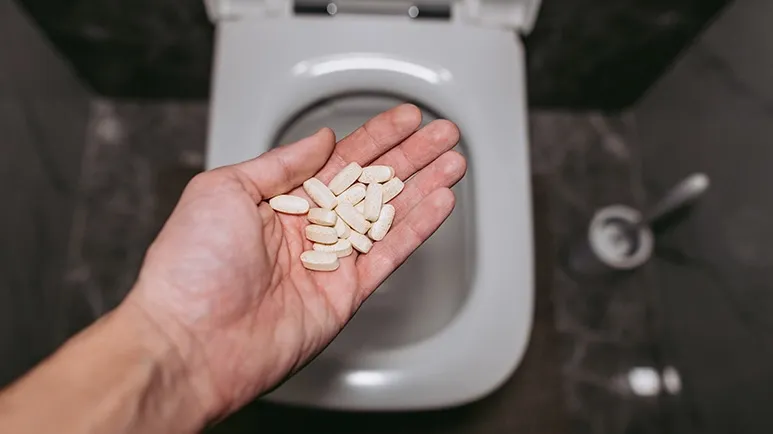
Many people don’t think twice about discarding these, but when flushed away into the environment, they disperse in water and land habitats and wind up inside a wide range of organisms, greatly affecting wildlife and ecosystems. These six items are among the worst.
STORY AT-A-GLANCE
- Drugs taken by humans and animals are flushed into the environment in sewage. They are also discharged by pharmaceutical production facilities
- Populations of many species living in human-influenced environments are on the decline for unknown reasons. It’s time to examine emerging issues like pharmaceutical pollution and its impact on wildlife and ecosystems
- The drugs deemed most harmful to animals and the environment include hormones, antibiotics, painkillers, antidepressants, anticancer drugs, and in veterinary medicine, antiparasitics
- Disturbing examples of the effect of pharmaceuticals on wildlife include the feminization of male fish by the synthetic hormones in birth-control pills, and vultures in India wiped out by an anti-inflammatory drug found in cattle carcasses
- In the U.S., the use of medications is increasing right along with the population of both humans and livestock, while sewage use to irrigate or fertilize farmland is also rising
Editor’s Note: This article is a reprint. It was originally published April 11, 2015.
Drugs taken by humans and animals are flushed into the environment in sewage, where they disperse in water and land habitats and wind up in a wide range of organisms. A special issue of the journal Philosophical Transactions B discusses the most current research into the risk of pharmaceuticals to the health and longevity of wildlife and ecosystems.1 According to Dr. Kathryn Arnold, one of the editors of the special issue:
“With thousands of pharmaceuticals in use globally, many of which are designed to have biological effects at low concentrations, they have the potential to have potent effects on wildlife and ecosystems.”2
Findings from the research reveal that a certain type of antidepressant causes starlings to eat less,3 and a contraceptive drug reduces fish populations in lakes.4
Arnold warns that since many species living in human-influenced environments are declining for reasons that have yet to be explained, it is time to investigate emerging issues like pharmaceutical pollution.
Half the World’s Wildlife Population Has Disappeared in Just 40 Years
Last September, the World Wildlife Fund published a report revealing that in just the last 40 years, half the world’s wildlife population has disappeared.5 And in bodies of fresh water, which is where most drug residues are found, 75% of fish and amphibians have been lost.
Disturbing examples of the effect of pharmaceuticals on wildlife include the feminization of male fish by the synthetic hormones in birth-control pills, and vultures in India wiped out by an anti-inflammatory drug found in cattle carcasses.
In a report produced by Germany’s Federal Environment Agency, the drugs most harmful to the environment were identified. Human drugs include hormones, antibiotics, painkillers, antidepressants, and anticancer drugs. The most harmful veterinary drugs include hormones, antibiotics, and antiparasitics.6
Pharmaceutical Companies Discharge Drugs Into the Environment
Drugs get into the environment not only from sewage, but also from discharges from pharmaceutical production facilities. Antibiotic pollution is a problem in China, India, Pakistan, Korea, Denmark, Norway, and Croatia, and promotes the development of drug-resistant pathogens.
Antidepressant pollution from producers in Switzerland, Israel, and Spain, and narcotic pollution in the U.S. are also a concern.
Also in the U.S., the use of medications is increasing right along with the population of both humans and livestock, while sewage use to irrigate or fertilize farmland is also rising.
Science Needs to Deliver Better Information About the Risks of Pharmaceutical Pollution on the Environment
According to Dr. Arnold:
“The research presented here shows that pharmaceuticals in the environment can impact upon birds, fish, frogs and other animals living in diverse habitats. In some cases the effects can appear quite ‘subtle’ — changes in feeding behavior or risk taking, for example. However, an animal that fails to find food or escape from a predator has a low chance of survival. Given the many benefits of pharmaceuticals, there is a need for science to deliver better estimates of the environmental risks they pose.”7
The special issue of the journal arose from a Research Fellow International Scientific Seminar held in April 2013. For more information the meeting report, titled “Assessing the exposure risk and impacts of pharmaceuticals in the environment on individuals and ecosystems,” can be downloaded here.
In this free guide, you’ll discover:
-
How your pet’s biology influences their nutritional needs -
Why conventional feeding advice often falls short -
Practical ways to choose better food for your dog or cat
View our Privacy Policy and Terms of Service.
