

STORY AT-A-GLANCE
- Arboreal folivores, animals that live in trees and eat leaves, are rare among vertebrates, leaving researchers questioning why there aren’t more such animals living among the tree tops
- A study on sloths revealed that energetic constraints as a result of the animals’ leafy diet has likely prevent diversification
- Three-toed sloths may use just 460 kilojoules of energy a day, which is akin to burning just 110 calories — the lowest measured energetic output recorded for any mammal
- Occasionally, sloths may drop from tree branches into a river, where they are surprisingly strong swimmers
- Modern-day sloths are much smaller than their ancient ancestors as well, especially the giant ground sloth, which lived in South America a few million years ago
Editor’s Note: This article is a reprint. It was originally published February 7, 2017.
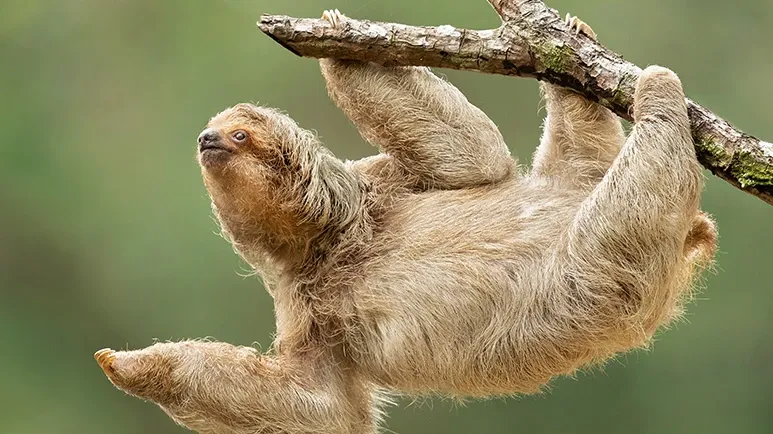
Arboreal folivores, animals that live in trees and eat leaves, are rare among vertebrates, even though much of the world is covered in forests. Sloths, which spend their days sleeping and munching leaves in the rainforest canopies of Central and South America, are one such animal.
These intriguing creatures are most known for their slow-motion lifestyle, which involves sleeping for 15 to 20 hours a day and often remaining motionless even when they’re awake.1 They have only two speeds: slow and slower.
Researchers from the University of Wisconsin-Madison wondered why, with trees in such plentiful supply, more animals haven’t diversified to take advantage of this widespread ecological niche (a process scientifically known as adaptive radiation). Why aren’t their tree-dwelling animals everywhere?
In a study published in the journal American Naturalist, they revealed it may be due to the “energetic constraints of a leafy diet,” which “seem to prevent adaptive radiation.”2
In other words, a diet of only plant leaves is not nutritionally robust enough to support many species, let alone those living among the branches. Sloths are unique in that they’re one of only a few that have adapted to thrive on a diet of solely leaves while living amongst the trees.
Sloths’ Slow-Motion Lifestyle Is the Result of Their Life in the Trees
University of Wisconsin professor of forest and wildlife ecology Jonathan Pauli, Ph.D., who co-authored the study, explained that among vertebrates, living in trees and subsisting on leaves “is the rarest of lifestyles.”
He said in a news release, “When you picture animals that live off plant leaves, they are almost all big — things like moose, elk and deer. What’s super interesting about arboreal folivores is that they can’t be big.”3
Sloths, however, are wonderfully suited to this lifestyle. They have “a suite of extraordinary adaptations to survive in forest canopies,” according to Pauli, including specially adapted limbs, reduced body mass, fulcrum-like claws and a slow metabolic rate.4
The researchers calculated the field metabolic rate (FMR), movement and body temperature for both two- and three-toed sloths, and while both expended little energy over the course of a day, the three-toed sloths were especially conservative in their energy expenditures.
It turned out they may use just 460 kilojoules of energy a day, which is akin to burning just 110 calories — the lowest measured energetic output recorded for any mammal (other animals with impressive energy-conserving capabilities include giant pandas, Australian rock rats and golden moles).
Doug Levey, Ph.D., program director in the National Science Foundation’s (NSF) Division of Environmental Biology, said in a University of Wisconsin-Madison news release:5
“This study explains why eating leaves in the canopies of trees leads to life in the slow lane, why fast-moving animals like birds tend not to eat leaves and why animals like deer that eat a lot of leaves tend to be big and live on the ground.”
Sloths Are so Slow They Grow Algae on Their Fur
Sloths are the world’s slowest mammal, moving so scarcely that algae grows on their fur (giving the animals a green cast that helps them blend in with the treetops).
In 2014, researchers also revealed “a wide variety of micro- and macro-organisms grow on their coarse outer hair,” including a novel source of fungi with potent antiparasitic, anticancer and antibacterial activity.6
They spend nearly all of their time in trees, mostly sleeping but also eating, mating and even giving birth in the tree canopy. On an average day, they may travel just 40 yards (120 feet).7
Their greatest disadvantage comes when they find themselves on land, as sloths are arboreal for a reason. However, and also surprisingly, they travel to the forest floor once a week to relieve themselves.8 According to National Geographic:9
“On land, sloths’ weak hind legs provide no power and their long claws are a hindrance. They must dig into the earth with their front claws and use their strong front legs to pull themselves along, dragging their bellies across the ground.If caught on land, these animals have no chance to evade predators, such as big cats, and must try to defend themselves by clawing and biting.”
Occasionally, sloths may drop from tree branches into a river, where they are surprisingly strong swimmers. This may be an age-old link to their ancient ancestors, who millions of years ago lived not only in trees but also on land and in water.
Modern-day sloths are much smaller than their ancient ancestors as well, especially the giant ground sloth, which lived in South America a few million years ago. Fossil discoveries suggest these giant sloths grew to be as big as elephants and weighed more than 8,000 pounds.10
2 Sloth Species Are Threatened
The future of sloths is intricately intertwined with the future of rainforests, which are at risk from deforestation. Without trees, sloths have no shelter and no food and are at grave risk from predators.
Of the six sloth species that still exist (at one time there were more than 50), two, including the pygmy sloth and the maned sloth, are in trouble (they’re critically endangered and vulnerable, respectively).11
Sloths are also targeted for sale in the illegal pet trade, particularly in Colombia, where they sell for $30 on the street.12
Sadly, with their highly limited diet and bodies designed for tree-top living, sloths do not make good pets and have a difficult time surviving outside of their native environment. In an interview with ABC News, zoologist Lucy Cooke explained:13
“They did not evolve to be somebody’s house pet … Sloths make lousy pets. That’s the truth of it … They’re highly specialized animals … That’s why you don’t find them in zoos.You don’t find three-fingered sloths in zoos in the States because they’re so difficult to keep. So the idea that any old Joe could just keep one as a pet is a bit of a fantasy, really.”
- American Naturalist August 2016
- UPI July 30, 2016
- 1, 9 National Geographic, Three-Toed Sloth
- 2, 3, 4, 5 University of Wisconsin-Madison July 20, 2016
- 6 PLOS One January 15, 2014
- 7, 8, 11 World Wildlife Federation, Sloths
- 10 Forbes October 20, 2016
- 12 Smithsonian May 30, 2013
- 13 ABC News May 28, 2013 (Archived)
In this free guide, you’ll discover:
-
How your pet’s biology influences their nutritional needs -
Why conventional feeding advice often falls short -
Practical ways to choose better food for your dog or cat
View our Privacy Policy and Terms of Service.
