

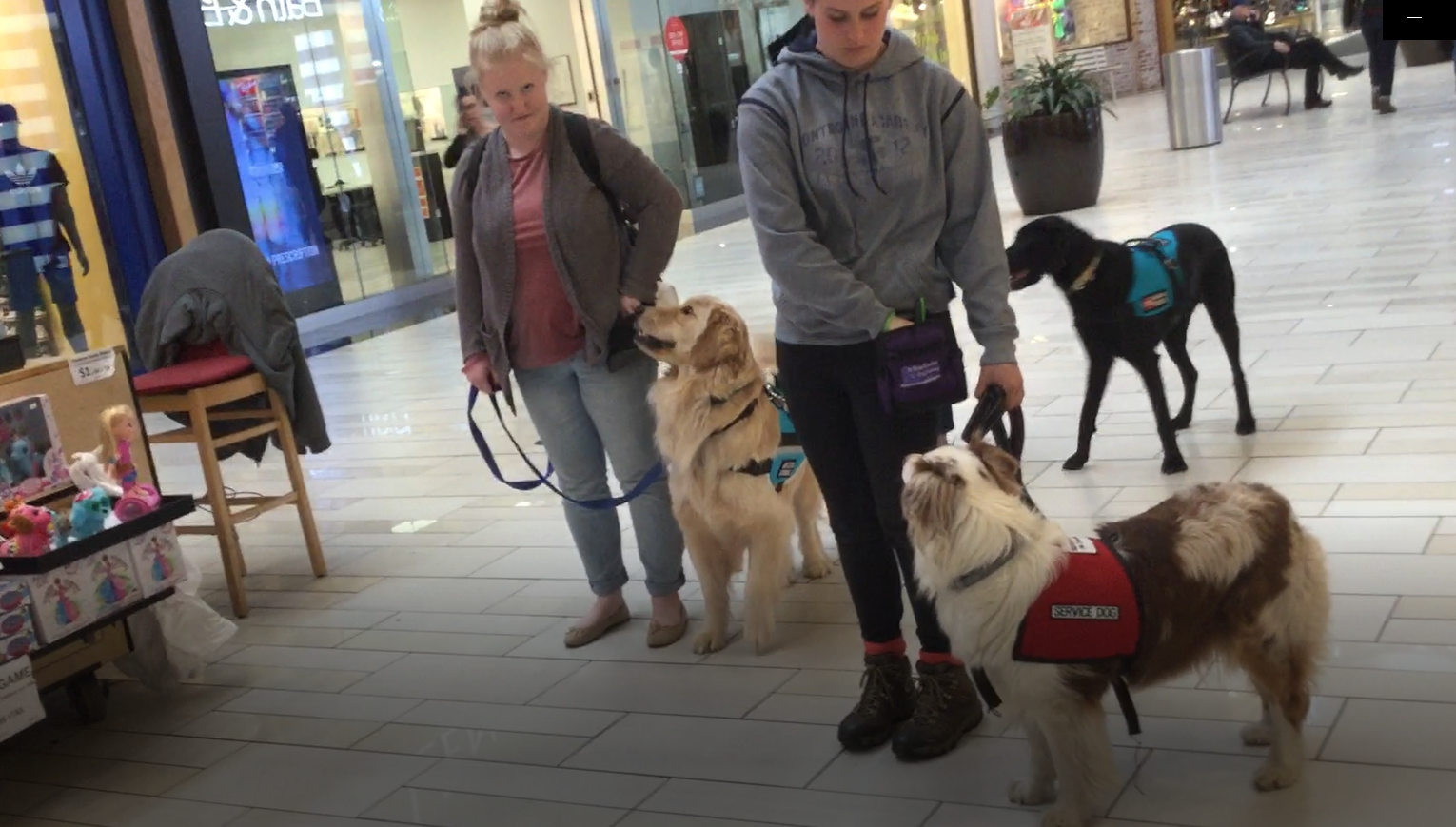
Other dogs are the most difficult distraction for most service dogs. In fact, overexcitement or even reactivity around other dogs is such a common public-access struggle that our online service dog foundations course considers calmly ignoring other dogs a critical set of foundation behaviors. We begin training to ignore other dogs starting in puppyhood. To be honest, ignoring other dogs isn’t one skill. It’s built with a coordinated set of strategies.
Eli and Alex each train a service-dog-in-training (SDiT) to ignore another dog in a loud, distracting public access environment
The Problem
As service dogs become more prevalent — and more public spaces allow pets — other dogs are everywhere. Your service dog needs to stay calm, cool, and collected around other well-behaved service dogs AND around pets, well-behaved or not.
Does More Exposure Help?
Some handlers introduce their puppy to as many dogs as possible, taking them to dog parks or day care. Unfortunately, this can backfire spectacularly. Puppies that get to meet or play with every dog they see will grow up to become dogs that expect to greet every dog. This creates great excitement around other dogs — far surpassing anything you can offer in comparison.
Then, when they are supposed to be working, over-excitement may turn into frustration or even aggression at thwarted expectations. This is true even if your dog LOVES other dogs and has only positive experiences with them. Instead, we want service dogs to learn that seeing other dogs is No Big Deal.
Can My Pup Ever Play with Other Dogs?
Absolutely! Your pup should have doggy friends — other puppies at similar developmental stages or adult dogs that are safe (vaccinated!) and friendly with puppies. In fact, assessing appropriate play and body language — and incorporating attention on you during play dates — sets up your pup to be happy, well-rounded, and more able to focus on you around distractions.
The key is to set up context-specific play dates AND also many opportunities to see other dogs and have nothing to do with them. Your dog learns that they will not get to say hi to other dogs outside specific scenarios.
Start Young
Start ASAP. An ounce of prevention versus a pound of cure. Train preventatively with your puppy as soon as they come home to avoid the issue entirely — or reduce it significantly, even when adolescence hits.
If you have an adult dog that already has developed bad habits with other dogs (as with Vicki and Houdini, below), take heart. Start now. Your dog can make remarkable progress.
I just started in PEARL DISC. My service dog was already professionally trained but was reactive to other dogs. He would lunge and bark at every dog in our neighborhood. She taught us “engage and disengage.” This training was EXACTLY right for us! In 5 days, he stopped lunging/barking at other dogs. To have done this with WITHOUT shocking or choking my dog is astounding to me. My dog is much more responsive to my voice commands and I think much happier too! –Vicki Ip & Houdini
It’s OK to Look!
One important concept to train your dog is that interacting with you, the handler, may be more interesting and valuable than other dogs. We train this concept in several different ways in our PEARL DISC foundations course.
The strongest teaching tool is a training exercise we call Engage/Disengage (also known as Click to Calm or Look At That).
Mark and reward when the pup looks at the distraction (Engage). This teaches your pup that it is OK to look at a distraction! It’s not fair or reasonable to expect our dogs to look at us all the time. They need to be able to absorb the environment, and then make the choice on their own to turn back to us (Disengage).
Train at a distance, so the only thing your dog is doing is looking — no lunging or barking. They practice calmly looking at the world around them without escalating. When that is easy for them and they can look at the other dog and then away, we can mark and reward bringing their attention back to you. They learn there is value in seeing interesting stuff and choosing to look at their human. The good stuff comes from their handler, not from the other dog.
Not Just For Other Dogs
Engage/Disengage can work for ANY big distraction! Use it for excitement with strangers, nervousness with leaf blowers, or curiosity about a gum wrapper on the sidewalk. For example, in the video below, because Christine’s puppy, David Bowie, is extremely excited about people, I (the trainer) am the distraction. I use this opportunity to coach the team through the Engage/Disengage process. You can see Bowie’s progress through regular practice. She starts very excited, pulling and jumping, but after many sessions she can sit calmly on a busy city street, under control and taking in the environment.
If your little puppy learns that you are more valuable than that dog over there (or that lawnmower), even when the distraction is closer or more intense, your dog has a foundation for making good choices. The more you play this training game with diverse distractions, the more your dog generalizes the concept, “There’s something I have big feelings about. I’m going to check in with my person for a snack!”
In the video below, Alex uses Engage/Disengage preventatively with their young puppy, Clippy. Even though Clippy is NOT showing fear or excitement about the lawnmower, Alex knows that large, noisy machinery can be distracting, scary, or exciting for dogs. So, they use this opportunity to teach their puppy that it’s OK to look at something weird or interesting, and that doing so will also earn them a treat when they look back.
Alex stands on a sidewalk in a Lowe’s parking lot, waiting for a fuzzy black puppy to look at a lawn mower, and then clicking when he looks, followed by giving him a treat.
Simple, but Not Easy
Engage/Disengage uses simple concepts, but the implementation takes skill and practice. Factors to be adjusted include the distance from the other dogs, timing of your event marker, value of your rewards, and the behavior of the other dog.
Other Skills to Help Your Service Dog Ignore Other Dogs
While engage/disengage is very useful, it’s not the only skill we need. Two other important foundation skills are
- Loose leash walking
- Settle (usually trained with a small mat or towel)
Training a truly relaxed long settle on a target, and then bringing that target into increasingly distracting environments, is a great way to transition relaxation to formerly exciting things. Train them to continue their behavior without having to worry about the other dog. Once your dog has some duration in their settle behavior and some skill with loose leash walking, find a place you can work at a distance from other dogs like a large park, or meet up with a handler friend to practice together.
In the video below, Alex and Eli do just that with Clippy and Bode. Bode and Clippy practice settling on a mat and walking past each other. By starting with some distance, both dogs are set up for success as the intensity of the distraction is more manageable from further away. By practicing like this, these dogs were able to build up to taking a walk together in a shopping mall (the video at the top of this post), but they don’t know each other at all outside of these training sessions. They have never “said hi” or played together!
Slow is Fast!
Working around other dogs is a difficult skill, even for highly trained service dogs. The best way to conquer any challenging goal is to
- Start small, training simple skills to fluency, including engage/disengage, relaxed settle, and leash manners
- Get professional support to “tweak the circumstances” and maximize your own skills
As you build up other skills in your dog, bring your training sessions to places where they can practice around other dogs at a level they can handle. Then, slowly decrease the distance between your dog and the distraction dogs. Remember, slow is fast. For individualized coaching on ALL of the skills outlined in this article, train your dog with us in PEARL DISC.
Happy training!
