

STORY AT-A-GLANCE
- Some of the cutest dog breeds — Corgis, Dachshunds, Bulldogs, French Bulldogs, and Basset Hounds — share a group of genetic condition called chondrodystrophy and chondrodysplasia, the most common forms of dwarfism in dogs, that has been deliberately bred into their lines
- That signature short-legged, long-bodied look of chondrodystrophy comes with a built-in cost: a much higher risk of back, disc, and spinal cord problems that can become emergencies if a disc compresses the spinal cord
- Pituitary dwarfism is a different, more serious form — caused by a pituitary gland that does not make enough growth hormone and other important hormones — and shows up most often in German Shepherds, with a life expectancy of just three to five years if left untreated
- Dogs with pituitary dwarfism face a long list of health issues, including hypothyroidism, thin coats, hair loss, recurring skin infections, hip dysplasia, luxating patellas, and eye problems like cataracts and retinal degeneration
- Neither form of dwarfism can be cured, but both can be managed — keeping your dog lean and protecting their back in cases of chondrodystrophy, and lifelong hormone replacement therapy in cases of pituitary dwarfism
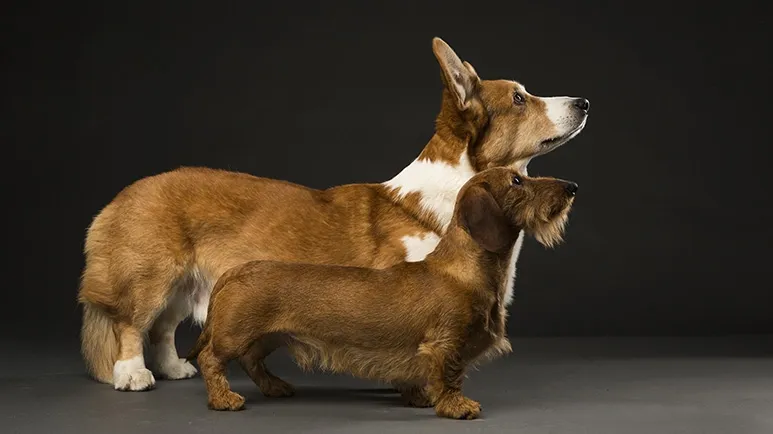
Some of the most adorable dogs on the planet share a common feature: short legs, stocky bodies, and oversized, expressive heads. These include Corgis, Dachshunds, Bulldogs, French Bulldogs, and Basset Hounds. Their look is iconic but it is not random. Rather, it is the result of a genetic condition called dwarfism, intentionally bred into the lines for generations.
Most of these dogs lead happy, full lives. But the same genetics that give them their charm also come with some real health considerations every pet parent should understand.
What Dwarfism Actually Is
Dwarfism in dogs is a genetic condition that causes abnormal growth and bone formation, usually resulting in a body that is out of proportion with its parts — short, sometimes crooked legs paired with an oversized head.1,2
There are three main forms in dogs: chondrodystrophy3,4,5 and chondrodysplasia (which are often grouped together), and pituitary dwarfism. They look different, they are caused by different things, and they affect dogs very differently.6
Chondrodystrophy and Chondrodysplasia: The ‘Cute’ One
Chondrodystrophy and chondrodysplasia are by far the most common forms of dwarfism in dogs. They are each caused by a genetic mutation that disrupts endochondral ossification — the process of cartilage hardening into bone — during fetal development, which disrupts the function of the growth plates. The mutation affects fibroblast growth factor receptors, which help regulate bone growth. Both mutations are a dominant trait, which means a dog only needs one copy of the mutated gene to show it.
And here is the thing: In many beloved breeds, this is not an accident. It is the standard. Chondrodystrophy and chondrodysplasia has been deliberately selected for in:7,8,9
- Dachshunds
- Corgis (Pembroke Welsh Corgis)
- Bulldogs and French Bulldogs
- Basset Hounds
- Pugs and Pekingese
- Petit Basset Griffon Vendéen
Dogs with chondrodysplasia and chondrodystrophy often share certain physical features: a larger-than-normal head, undershot jaw, shorter nose, crooked teeth, enlarged joints, corkscrew tails, and bowed limbs. The short-nose, undershot jaw, and corkscrew tail characteristics are attributed to different gene mutations but are often seen in the breeds that carry the dwarfism gene(s).
The Health Trade-Off
Most dogs with chondrodysplasia and chondrodystrophy live perfectly normal lives. But their long, low bodies do come with built-in risks — particularly for the back.
Dogs with this body shape, in particular dogs with the chondrodystrophy gene mutation, are more prone to spinal cord and disc problems, including intervertebral disc disease. Some can also experience spinal deviations, hemivertebrae, brachycephalic syndrome (in flat-faced breeds), and angular or rotational limb deformities.10,11
Why? In part because that long, low frame puts steady pressure on the spine, and disc problems become much more likely if a dog is carrying extra weight. As one veterinarian puts it, these disc problems can be painful — and sometimes turn into emergencies when a disc compresses the spinal cord. In those cases, medical and sometimes surgical intervention has to happen quickly, or the dog can lose the ability to walk. The takeaway for pet parents:
- Keep your dog lean and fit — extra pounds are hard on their back
- Avoid reckless jumping (off the couch or bed or out of the car)
- Watch for any signs of back pain, weakness, or trouble walking
- Get to the veterinarian fast if mobility suddenly changes
Pituitary Dwarfism: The Less-Known, More Serious Form
Pituitary dwarfism is a different story. It is uncommon, it is not selected for on purpose, and it tends to come with a long list of health problems. Also called hypopituitarism, it happens when the pituitary gland in the brain fails to produce enough growth hormone. This usually traces back to a recessive genetic mutation, meaning a dog needs two copies of the gene to show it. In rare cases, the gland can also be damaged at birth — from lack of oxygen — or later from brain tumors, traumatic brain injury, or inflammatory conditions.
Pituitary dwarfism is most commonly seen in German Shepherds, where it gives affected dogs a distinctive coyote-like or “miniature German Shepherd” appearance — small body, big ears, patchy coat. It has also been reported in the Tibetan Terrier, White Swiss Shepherd, Lapponian Herder, Finnish Spitz, Miniature Pinscher, Karelian Bear Dog, and, more rarely, in Weimaraners, Golden Retrievers, Labrador Retrievers, and Rottweilers.
Affected puppies are usually noticeably smaller than their littermates and grow slowly. Adult dogs may not reach skeletal maturity until they are about 4 years old.12,13,14
What to Watch For
Dogs with pituitary dwarfism are at risk for a wide range of health issues. These include:15,16
- Slow growth and delayed eruption of adult teeth
- Hypothyroidism (underactive thyroid)
- Abnormal tooth alignment and dental issues
- Thin, fragile coat and patchy hair loss
- Recurring skin problems and infections
- Poor muscle mass
- Hip dysplasia and luxating patella
- Eye problems, including cataracts and retinal degeneration
Without treatment, the life expectancy for dogs with pituitary dwarfism is only 3 to 5 years. Most are also infertile — which is actually a positive, since no dog with this condition should be bred.
Diagnosis and Treatment
If a puppy is much smaller than littermates, a veterinarian can confirm pituitary dwarfism through radiographs (X-rays), which would show decreased ossification, blood tests measuring growth hormone, and creatinine levels (often elevated in affected dogs). Genetic testing is also available. Having littermates to compare results against can be helpful.
For chondrodysplasia and chondrodystrophy, genetic testing can be performed to confirm the gene mutations.
Because any of the forms of dwarfism are genetic (with the rare exception of acquired hypopituitarism), there is no cure for either form. But treatment can make a real difference.
For pituitary dwarfism, hormone replacement is the standard approach. Many of these dogs need thyroid medication for life, and porcine (pig) growth hormone is sometimes used — human growth hormone is not a workable option because dogs develop antibodies against it. Skin problems and infections also need prompt care. With consistent treatment, a dog with pituitary dwarfism may be able to live a full life.17,18,19
For chondrodystrophy, there is no specific treatment. Management includes weight management and preventative measures to reduce risk of back and neck injuries.
The Bigger Conversation
There is a growing discussion in the animal welfare community about what we ask of dogs when we breed for certain looks. Selecting for dwarfism — that signature short-legged, long-bodied silhouette — comes with predictable health costs.
Animal welfare advocates are increasingly urging breeders and buyers to think carefully about the unintended consequences of those choices. None of that takes away from how much these dogs are loved. It just means going in with eyes open.
A Happy Life Is Still Within Reach
Whether your dog has chondrodystrophy or chondrodysplasia by design or pituitary dwarfism by chance, awareness is half the battle. Most dwarf dogs can live happy, fulfilling lives when their pet parents understand the risks and plan around them — keeping weight in check, preventing back-jarring jumps, staying on top of skin and dental care, and never skipping hormone therapy when it is prescribed.
That short-legged, big-eared, oversized-head charm is part of what makes these dogs so unforgettable. Just give them the lifelong care that goes with the territory — and they will keep being the cutest pets around, with the longest, healthiest life you can give them.
- 1,8,11,13,15,18 Whole Dog Journal, May 4, 2026
- 2,9,14,16,19 American Kennel Club, September 27, 2024
- 3 Proc Natl Acad Sci U S A. 2017 Oct 11;114(43):11476–11481
- 4 UC Davis, Managing the Genetics of Chondrodystrophy (CDDY)
- 5 UC Davis, Chondrodystrophy (CDDY and IVDD) and Chondrodysplasia (CDPA)
- 6,7,10,12,17 Hill’s Pet, May 27, 2022
In this free guide, you’ll discover:
-
How your pet’s biology influences their nutritional needs -
Why conventional feeding advice often falls short -
Practical ways to choose better food for your dog or cat
View our Privacy Policy and Terms of Service.
