

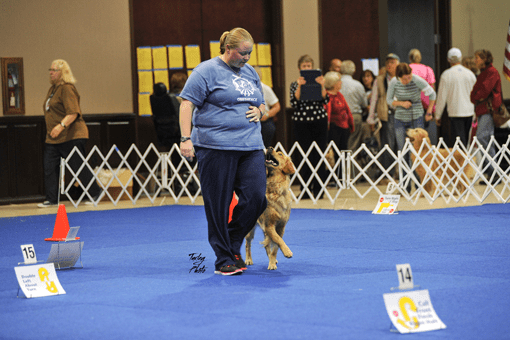
Ask most rally handlers what they work on in practice, and rally transitions between signs rarely make the list. Heeling. Fronts and finishes. Position changes. Specific signs that keep going sideways. It’s a reasonable list. Those things matter.
But there’s a piece of rally that almost nobody trains intentionally, and it shows up in every run. It’s the space between the signs. The moment after you complete one sign and before you begin the next one. The three or four steps of heeling that connect everything together.
Transitions. And if you’ve never thought about them as something to train, you’re not alone.
What Rally Transition Between Signs Means
A transition is everything that happens between signs. It starts the moment you finish executing one sign and ends the moment you set up for the next one. It includes the heeling footwork that carries you from point A to point B, your dog’s position during that movement, where their attention is, and how both of you mentally and physically prepare for what’s coming next.
On a well-run course, transitions are invisible. The team flows from sign to sign with connection and purpose, and it looks effortless. On a struggling course, transitions are where things fall apart. The dog checks out. The heeling gets sloppy. The handler rushes or hesitates. By the time they reach the next sign, they’re already a little behind.
The signs themselves often look fine in isolation. It’s the getting there that’s the problem.
Why Rally Transitions Between Signs Fall Apart
The most common reason transitions break down is simple: we never trained them. We trained the signs as individual skills, practiced them until they looked good, and then assumed the heeling between them would take care of itself. But transitions aren’t automatic. They’re a skill, and like any skill, they need to be taught.
There are a few specific things that tend to go wrong.
The first is a mental checkout. Your dog completes a sign, gets a little reinforcement history hit from having done something, and uses the transition as a moment to decompress. They’re still moving with you, but they’re not really with you. Their eyes drift, their position loosens, and by the time the next sign arrives they’re a step behind mentally before they’re even a step behind physically.
The second is handler distraction. You finish a sign and immediately start thinking about the next one. Your eyes go to the sign ahead, your body shifts toward it, and your attention leaves your dog entirely. Your dog, who is an expert in reading you, notices. They were working with a connected handler a moment ago and now they’re just following someone who has mentally moved on without them.
The third is a position problem. Transitions involve heeling, and heeling has criteria. But a lot of teams hold themselves to looser standards between signs than they do during them. The heeling that happens between signs is still heeling. If your dog is wide, lagging, or disconnected during transitions, those aren’t free mistakes. They’re the same errors you’d lose points for anywhere else on the course, and they’re setting up the next sign to start from a less than ideal place.
Training Rally Transitions as a Skill
Once you start thinking about transitions as something to train rather than something that just happens, a few things become possible.
The first is teaching your dog that the work doesn’t stop when the sign does. This is a mindset shift for a lot of dogs. They’ve learned, often accidentally, that completing a sign is a natural pause point. The reinforcement history around signs is dense, and the history around the heeling between them is thin. That imbalance shows up in how seriously your dog takes the space between signs.
One simple way to address this is to reinforce during transitions, not just at signs. Mark and reward your dog for a connected moment of heeling between signs, not just for the sit or the front or the pivot. Build a reinforcement history that covers the whole course, not just the highlighted moments.
The second is training connection through the transition, not just position. A dog can be physically in heel position and still be mentally somewhere else. What you’re looking for in a good transition is a dog who is with you, attentive, and ready. That quality of engagement is trainable, but it requires you to notice when it’s there and when it isn’t, and to reinforce the moments when your dog is genuinely checking in rather than just moving alongside you.
The third is thinking about your own role in the transition. Where are your eyes going? What is your body doing? Are you giving your dog something to stay connected to, or are you mentally three signs ahead? Handlers who stay present through the transition give their dogs a reason to stay present too.
What This Looks Like in Practice
A few things worth adding to your training sessions if transitions are a weak spot.
Train short sequences instead of individual signs. Two or three signs connected by real heeling gives you actual transitions to work with. You’ll quickly see where connection drops and where your dog is genuinely with you versus just going through the motions.
Vary where you reinforce. If your rewards always come at signs, start occasionally rewarding during the heeling between them. A well-timed mark for a connected moment of heeling in a transition can shift your dog’s understanding of where the job is.
Video is one of the most useful tools you have. It’s easy to evaluate a run by how the signs looked. Watch it again and pay attention only to what happens between them. You may be surprised by what you see.
Most handlers walk a course thinking about the signs: what they require, how to execute them, where the flow goes. That’s a good start. But add one more layer to your walk-through. Notice where the transitions are long, where they’re short, where the course asks you to cover a lot of ground quickly, and where you might be tempted to rush. Those spots are worth thinking about before you run them.
The Runs That Feel Easy
If you’ve ever had a run that just felt easy, where you and your dog were in sync from start to finish and the whole thing flowed, transitions were probably a big part of why. Those runs don’t happen because every sign was perfect. They happen because the team was connected throughout, including in the spaces between the signs.
That feeling isn’t luck. It’s something you can build.
