

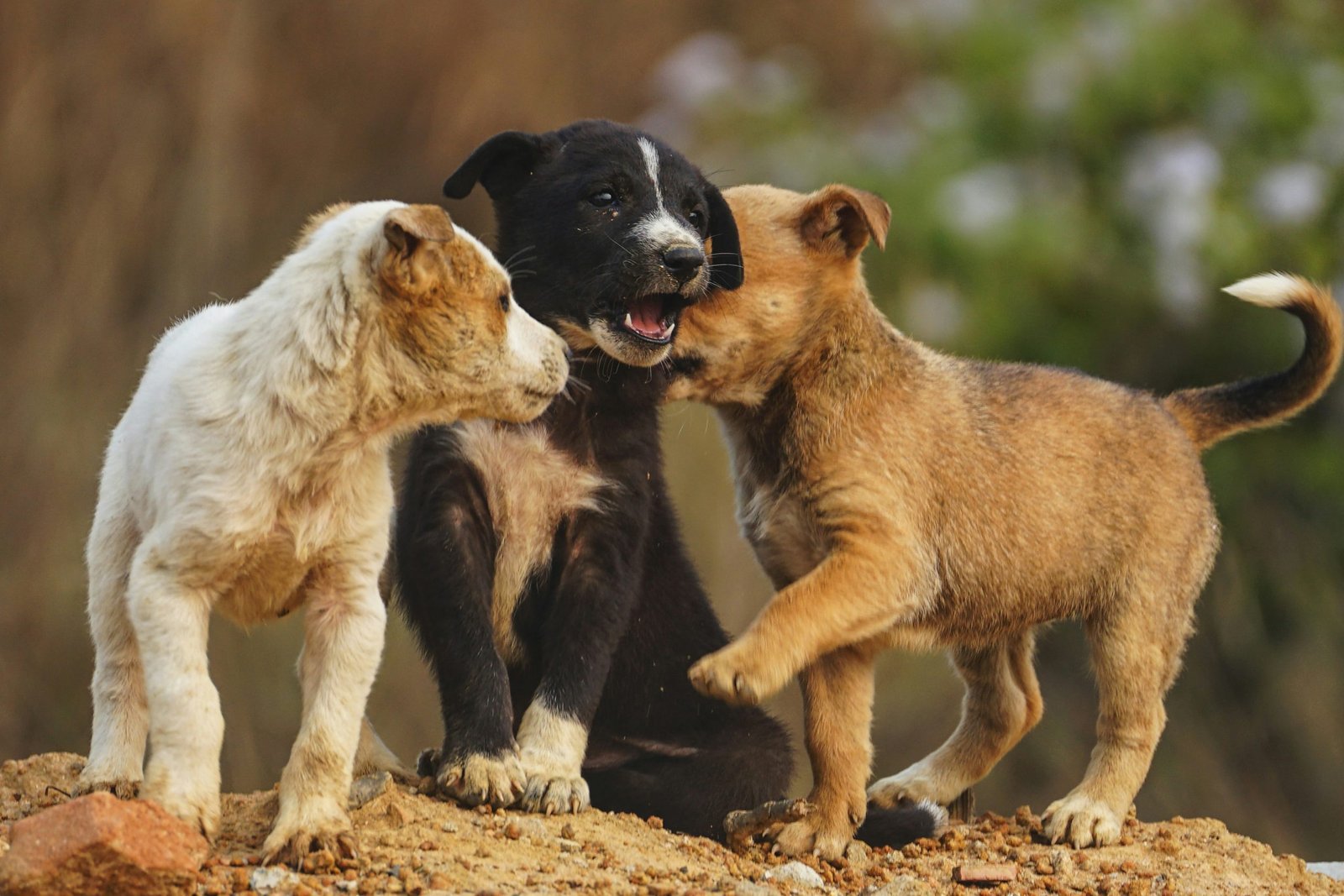
What Is Healthy Puppy Play?
Healthy puppy play teaches young dogs how to communicate, develop bite inhibition, and navigate social relationships. These early interactions are not just about burning energy. They are where puppies learn how to read other dogs, respond appropriately, and adjust their behavior in real time.
Healthy puppy play isn’t always quiet or gentle. It can be bouncy, messy, and full of silly noises that sometimes surprise new owners. Growling, wrestling, and chasing are all normal parts of play, even when they look intense on the surface.
The most important thing is that both puppies are choosing to play, enjoying themselves, and willing to return for more. When play is healthy, you’ll see loose bodies, soft facial expressions, and natural pauses where both puppies reset and then choose to continue interacting. Those choices matter more than how the play looks at first glance.
Signs of Healthy Puppy Play
Healthy puppy play has several predictable traits, and once you know what to look for, it becomes much easier to recognize. One of the biggest indicators is body language. Look for loose, wiggly bodies and curved movements rather than stiff, straight lines.
You’ll also see puppies taking turns with who is on top or who is doing the chasing. Balanced play includes role reversals, where each puppy gets a turn being the “chaser” and the “chased.” This back-and-forth pattern helps keep play fair and enjoyable for both dogs.
Another important piece is the presence of play bows and quick pauses. These brief breaks might only last a second or two, but they serve an important purpose. They allow both puppies to check in with each other and decide whether to keep playing.
When play is healthy, both puppies initiate interaction and both respond positively when the other invites play again. That mutual participation is one of the clearest signs that everything is going well.
How Healthy Puppy Play Teaches Communication
Healthy puppy play is how dogs learn to “speak dog.” Puppies experiment with behaviors like growling, barking, wrestling, pinning, and chasing, and they learn through feedback from their playmate. If one puppy goes too far, the other may disengage, vocalize, or pause, and that response helps shape future behavior.
Even behaviors that look intense, like grabbing necks or tumbling around, are not automatically concerning when the puppies look relaxed, happy, and willing to continue. Context matters much more than the individual behavior itself.
Mistakes are a normal and necessary part of the process. Puppies are not born with perfect social skills. Healthy puppy play gives them the opportunity to problem-solve, adjust their behavior, and figure out what works and what doesn’t. Over time, this builds better communication and more appropriate interactions.
When Puppy Play Isn’t Healthy
Sometimes, puppy play becomes too rough or one puppy begins to feel overwhelmed. The shift from healthy to unhealthy play can happen quickly, especially as excitement builds and arousal increases.
Unlike healthy puppy play, unhealthy interactions tend to lose their balance. You may notice a lack of role reversals, where one puppy is always chasing or always being pinned. The natural pauses that you would normally see start to disappear, and the interaction becomes more one-sided.
You might also see chasing that never switches directions or one puppy constantly pinning the other without giving them a chance to get up. When one puppy is no longer an active, willing participant, the interaction has changed and needs support.
The overwhelmed puppy may try to disengage, hide behind a person, roll into a stiff stop, or freeze. These are important signals. This is when intervention is appropriate, not because play itself is wrong, but because the balance has shifted.
Red Flags of Unhealthy Puppy Play
Some body language cues clearly indicate that play has become uncomfortable. Instead of loose, wiggly movement, you may start to see stiffness in the body. Tails may tuck, movements may become more rigid, and the overall tone of the interaction changes.
Other signs include lip licking, averted eyes, or a puppy repeatedly trying to escape but being followed and re-engaged. These behaviors often show up before more obvious signs, so catching them early can make a big difference in preventing escalation.
Frequent mounting can also be a sign of stress or lack of social skill rather than true playfulness. While it may look like play, it often reflects overstimulation or uncertainty rather than enjoyment.
If one puppy keeps trying to retreat and the other won’t allow it, this is no longer healthy puppy play. These signals mean a puppy is uncomfortable and needs your support to create space and reset the interaction.
How to Step In Without Ruining the Fun
Your job isn’t to constantly manage play or interrupt every moment of excitement. Instead, your role is to keep interactions safe, balanced, and confidence-building for both puppies.
When you do need to step in, keep it calm and low-pressure. You can step between the puppies, call them apart, or scatter treats on the ground in opposite directions to create space. This helps break the intensity without adding stress or frustration.
After a short pause, take a moment to assess their body language. If both puppies choose to re-engage and return to loose, wiggly movement, that’s a good sign that the play is still healthy and they’re ready to continue.
These short resets are part of good play, not a disruption of it. They help keep things from escalating too far while still allowing puppies to learn.
Supporting Healthy Puppy Play at Home
The best environment for healthy puppy play includes thoughtful setup, appropriate play partners, and supervision that protects emotional safety. Not every puppy is a good match for every other puppy, even if they are similar in age or size.
Matching puppies by energy level and play style is much more important. A high-energy, rough player may overwhelm a more sensitive or slower-paced puppy, even if they are physically similar. The goal is compatibility, not just convenience.
Short play sessions are also more effective than long ones. Stopping before puppies become over-aroused helps keep play positive and prevents that shift into unhealthy interactions. It’s much easier to maintain good play than to fix it once it has escalated.
Your role is to observe, protect confidence, and allow learning to happen. When puppies are given the chance to experiment with body language, make small mistakes, and adjust, they develop the skills they need to become confident adult dogs who can interact politely and safely with others.
