

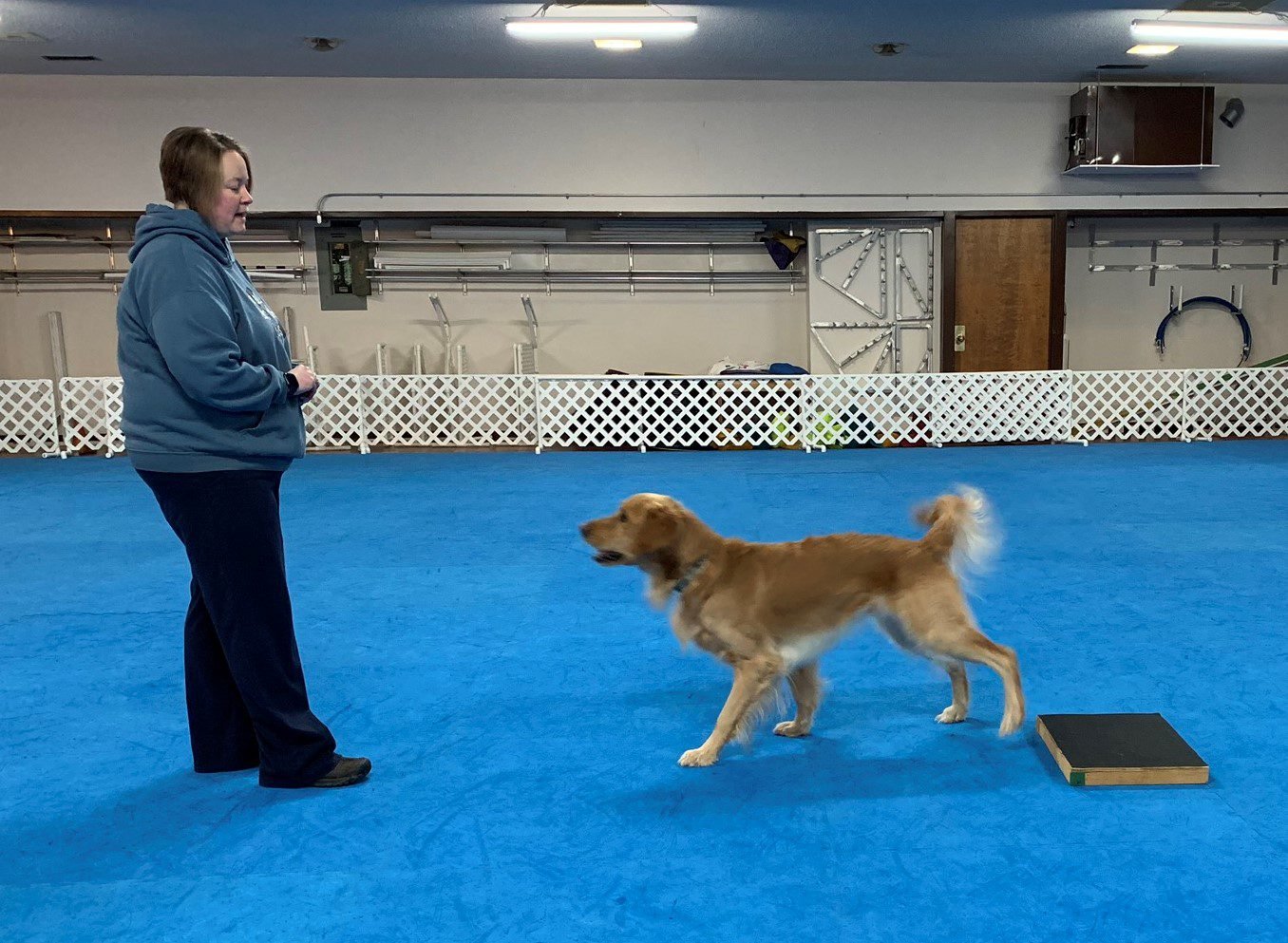
Teaching your dog to back up is not only a cute parlor trick, but it’s also useful for obedience, rally, and agility. There are many ways to teach back, but I’ve had the most success using a rear-foot target.
The Advantages of the Rear-Foot Target Method for Teaching Your Dog to Back Up
A rear-foot target gives the dog really clear information about where their back feet belong. It creates a picture they can repeat, and it helps them become deliberate with their movement instead of flinging themselves backward or guessing.
It’s also my go-to because it avoids two common problems:
No luring required. Luring can get a backup started, but it’s often hard to fade cleanly. A lot of dogs learn “follow the cookie” instead of “move your feet on purpose.”
No body pressure. Some methods rely on stepping into the dog, leaning forward, or using your body to make backing the easiest option. That can work, but it can also create conflict, slow learning, and it’s also hard to fade without the behavior falling apart.
With a rear-foot target, the dog learns how to back up because the behavior makes sense, not because they’re trying to avoid pressure or chase food.
Teaching Your Dog to Back Up: Put Value Into Standing on the Target
The first step in teaching a backup is putting value into that two-feet-on, two-feet-off position. You want your dog’s rear feet to be on a slightly raised target and their front feet on the floor. To start, toss a treat out away from you, with the target between you and the treat. As the dog comes back toward you and gets on the target, mark and feed when the dog has two feet on and two feet off.
This is Rise’s first session. The entire session was spent putting value into this position. I want him to want to be there!
During this second session, I am working on bringing the treats forward ever so slightly. My goal is to get one back leg to come off the target. When that happens, I pause and wait for the dog to put it back. Sometimes things can get a bit messy, with the dog offering downs and sits instead, in which case I just toss a reset treat. Once the dog sits or downs, he won’t back up so I immediately reset and start the next rep.
In the middle of this video, you can see how Rise is starting to stretch forward, keeping his back feet on but moving toward the treat. This is exactly what I want, and it shows he’s thinking about keeping those feet on!
When he does come off the target, he comes off too far, so I reset. He laid down the second time he came off, so that called for another reset. He’s not quite understanding the backup part yet, but I was really happy to see that stretching forward.
Expect Imperfect Sessions
Here is session three. It’s a bit long, but I wanted to show you the entire training session. Things will get messy during this training; you’ll drop treats, the dog will come off too far, and you’ll need to reset. But you’ll slowly see things coming together.
Right around :12, we have our first bit of back! I rewarded several times for that, then reset. In this session, I did a better job bringing the treats forward just enough to get one foot off.
On the next rep, Rise sat so I immediately reset. When he came back from that, he showed a moment of brilliance as I dropped a treat and he stopped with two feet on the target! Smart dude!
Throughout this session, we made lots of good progress. We also had many little oopsies, with dropped treats or me bringing him forward too much. Regardless, he really started to figure it out.
Here is session four. I was really happy with this. You can see Rise deliberately backing up several times. Even though he was starting to figure it out, he still offered a sit instead of backing up. I simply tossed a reset treat.
Teaching Your Dog to Back Up: Slowly Increase Distance
Once your dog learns how to get those back feet on the target, the training goes very quickly. Keep incrementally increasing the distance that your dog has to back up. Ping-pong the distance, ensuring you go from hard to easy and back again. I don’t always want to make it more difficult for my dog. End the session with a slightly easier rep.
Here’s Excel demonstrating a big dog backup for you. Notice he’s still backing up to that rear foot target.
I’m feeding in position here, then luring him off the board with another treat. You can always mark and just feed out of position to set the dog up for the next rep. If your dog needs a bit higher rate of reinforcement, you can feed two treats for each rep like I’m doing here.
Teaching Your Dog to Back Up: Adding a Back-Up Cue
At this point, the behavior is quite predictable so I can attach a verbal cue. My super creative cue is “back.” Say the cue just before the dog starts to back up.
Teaching your dogs to back up is a valuable skill that will be useful in your future training! Take it slow and break it down into manageable steps, and soon your dog will be backing up like a pro!
