

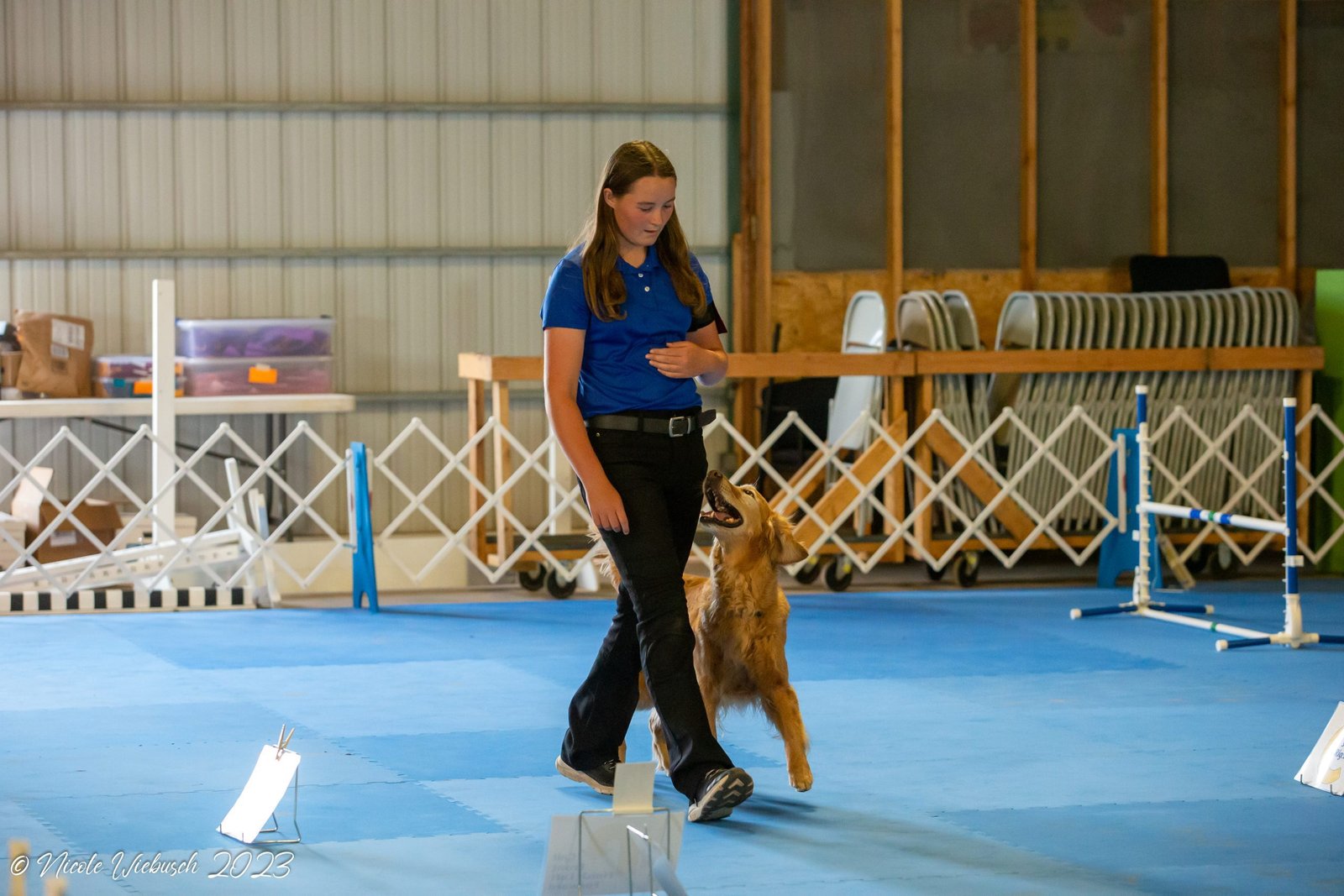
Mental prep for rally trials is something that often gets overlooked, even though it plays a huge role in how both you and your dog perform in the ring.
When we talk about preparing for rally trials, most of the focus tends to be on skills. Are the fronts straight? Are the finishes clean? Can your dog pivot without swinging wide? Have you practiced the signs under distraction?
All of that matters. But there is another half of the team that needs just as much preparation, and that is you.
You can have a beautifully trained dog and still feel your heart rate spike the second the judge asks if you are ready. You can walk a course perfectly in practice and suddenly blank on a sign you have done countless times. Nerves are not a sign that you are unprepared. They are a sign that you care. The goal is to learn how to manage them so they support your performance instead of working against it.
Mental Prep for Rally Trials Starts with Predictability
One of the biggest contributors to trial nerves is unpredictability. When something feels unknown, your body naturally goes on high alert. The more pieces you can make familiar, the calmer both you and your dog will feel.
Consistent training is the foundation. This means not just practicing individual signs, but working on transitions, sequencing, and full courses so your dog understands that rally is a continuous conversation between the two of you.
Mock trials and fun matches can be especially helpful because they replicate the rhythm of an actual event. Set up ring gates, have someone act as the judge, and walk through the entire process from start to finish. The more you rehearse the full experience, the more predictable it becomes.
Predictability builds confidence, and confidence lowers stress.
Using Mental Prep for Rally Trials to Support Performance
After walking your course, it is easy to start second-guessing yourself or focusing on what might go wrong. This is where mental prep for rally trials can make a real difference.
Take a moment to mentally rehearse a successful run. Picture your dog moving through the course with engagement and accuracy. Imagine smooth transitions and clear communication between you and your dog.
This kind of visualization gives your brain a clear plan to follow. It helps shift your focus away from worry and toward execution.
The goal is not to ignore the possibility of mistakes, but to give your mind a better direction to follow.
Mental Prep for Rally Trials Includes How You Talk to Yourself
Pay attention to what you are telling yourself before you enter the ring. Thoughts like “He always misses that sign” or “I am going to mess this up” create tension, and that tension shows up in your body.
Your posture changes, your breathing becomes shallow, and your dog feels that shift.
Mental prep for rally trials includes choosing thoughts that support your performance. That might sound like, “We are prepared,” “I can handle whatever happens,” or “My job is to support my dog.”
These are not empty statements. They help regulate your body and create a calmer, more stable presence for your dog.
Regulating Your Body Is Part of Mental Prep for Rally Trials
Your dog notices your body before they respond to your cues. If your breathing is shallow and your muscles are tight, your dog will feel that immediately.
Simple physical strategies can help you reset before you enter the ring. Taking a few minutes to breathe slowly and intentionally can lower your heart rate and reduce tension.
You can also use small techniques like briefly tightening and releasing different muscle groups to help your body relax.
Some handlers find that strong sensory input, like peppermint candy or music, helps shift their focus and interrupt anxious thought patterns.
Mental prep for rally trials is not just about what you think. It is also about what your body is doing.
Supporting Your Dog Through Mental Prep for Rally Trials
Just as predictability helps you, it also helps your dog.
Exposing your dog to different environments, surfaces, sounds, and distractions during training reduces the novelty of trial settings. A dog who has practiced working calmly around other dogs without expecting interaction will have much more clarity in the ring.
If you have the opportunity to visit a trial location ahead of time, that can also help reduce uncertainty for both of you.
The more familiar the experience feels, the easier it is for your dog to stay engaged and focused.
Reflecting After the Trial Is Part of Mental Prep for Rally Trials
Mental prep does not stop when you leave the ring. Taking a few minutes to reflect after your run helps you continue to build confidence and clarity.
Look at what went well and where you might want to improve. Keep it specific and constructive.
It is just as important to acknowledge the things that went right. Maybe your dog stayed engaged despite distractions, or your start felt calm and confident.
Progress in rally happens in layers, and not every success is measured by a score.
Mental Prep for Rally Trials Builds Stronger Teams
Preparing for rally trials is not just about teaching behaviors. It is about building steadiness, resilience, and trust on both ends of the leash.
When you put as much thought into your mental prep for rally trials as you do into your dog’s training, you walk into the ring ready to support your dog, no matter what happens.
That is what creates confident handlers, steady dogs, and strong teams.
