

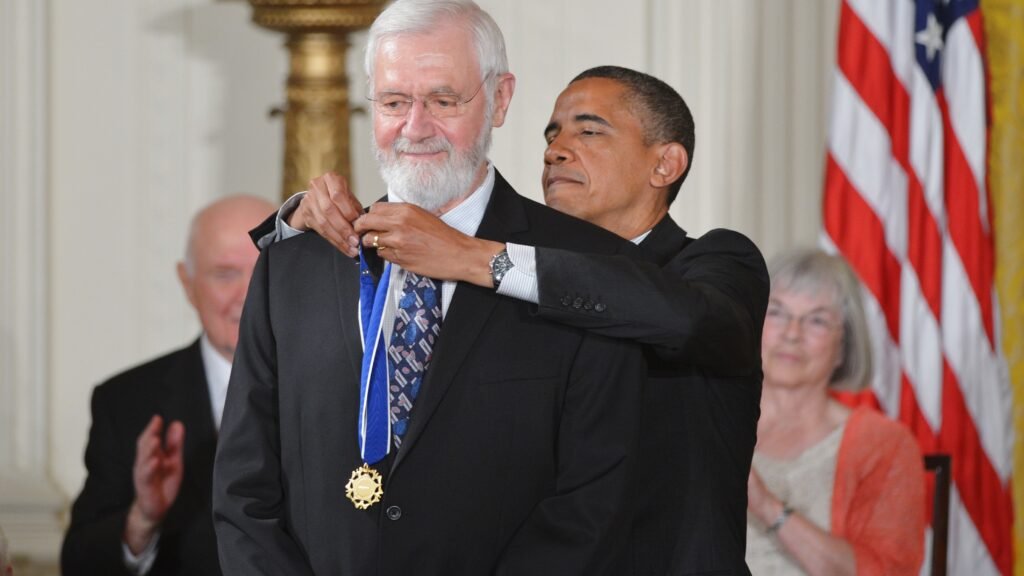
William (Bill) Foege, credited by many for shepherding the smallpox eradication effort to completion, died Saturday at the age of 89. A towering figure, both literally — he was 6’ 7” — and figuratively, Foege epitomized all that was positive about an era of public health that saw enormous gains made both in the United States and abroad.
He served as director of the Centers for Disease Control and Prevention from 1977 to 1983, capping 23 years of service with the agency. He was a founding member of the Task Force for Child Survival (now called the Task Force for Global Health), the first executive director of Carter Center — President Jimmy Carter’s human rights and global health focused alternative to a presidential library — and worked for a time as a senior medical adviser to the Gates Foundation.
His death occurred in the week that the U.S. finalized its withdrawal from the World Health Organization and the chairman of a panel that advises the CDC on vaccination policy mused about whether polio and measles vaccination is still needed — two developments that horrified him, a close friend and longtime colleague, Mark Rosenberg, revealed.
“The destruction of the infrastructure for vaccination and the confusion it caused, together with the withdrawal from the World Health Organization, made him very, very angry,” Rosenberg said in an interview Sunday. “I wish we could have spared him from seeing that.”
Last February, when it appeared that the CDC’s Epidemic Intelligence Service program, which trains public health workers on how to investigate disease outbreaks, was in the crosshairs of Trump administration budget cutters, Foege expressed incredulity in an interview with STAT.
Former CDC Director William Foege: How public health can fight back in a time of dangerous nonsense
“It’s almost beyond belief,” he said at the time. “When I hear about us leaving WHO or leaving the Paris [Climate] Agreement, we’re cutting out the EIS — a chill goes up my spine. Because I realize that we’re dealing with people who are in a different reality. They don’t understand public health. They don’t understand what it was like to encounter the dangers of the past.”
He also expressed deep concern about the actions of health secretary Robert F. Kennedy Jr., a critic of vaccines who has taken a string of actions to undermine their availability and use since taking office.
“Kennedy would be less hazardous if he decided to do cardiac surgery. Then he would kill people only one at a time rather than his current ability to kill by the thousands,” he wrote in an opinion piece for STAT in August.
Foege, however, always stressed the importance of optimism — a point made by his mentee Tom Frieden, who was director of the CDC during the Obama administration. “He talked about how there’s no point in being pessimistic, because then you’re disappointed once, and you’re disappointed a second time when things don’t work out. If you’re an optimist, you’re only disappointed once,” said Frieden, president and CEO of Resolve to Save Lives, a nonprofit organization.
Rosenberg said he thought Foege’s optimistic streak helped him cope with the anger he felt about the damage the Trump administration and Kennedy are inflicting on public health.
“There were lots of children alive all around the world because of what public health had done for them. There were lives saved. There were people trained, there were people who were committed to becoming better ancestors,” Rosenberg said, referring to Foege’s goal of making the world a better place for future generations. “And I think that gave him some relief from the horror of what was happening.”
Foege left an enormous footprint on global health, said Bill Gates, who Foege advised during the Gates Foundation’s early days.
“Bill was a towering figure in global health — a man who saved the lives of literally hundreds of millions of people,” Gates said in a statement. “He was also a friend and mentor who gave me a deep grounding in the history of global health and inspired me with his conviction that the world could do more to alleviate suffering. … The legacy of his career is that many of the remarkable developments to come will have his imprint all over them.”
Though the list of his achievements was long, Foege — whose name was pronounced FEY-gee, with a hard G — was as well known for his unwillingness to claim credit as he was for the accomplishments themselves.
“If the world had leaders like Bill Foege today, we would have a much better world,” said David Heymann, a former high-ranking WHO official who teaches at the London School of Tropical Medicine and Hygiene, and who worked on smallpox eradication in India under Foege.
Anne Schuchat, a long-time CDC official who was principal deputy director when she retired in 2021, described Foege as “a very humble giant in our field.”
“He was very visionary and very humble. Very funny. I mean, extremely witty, very clever, but also collegial,” she told STAT. “There are people like that in public health, I have to say. It’s one of the best things about the field. But he really did stand out. Very beloved, very much respected.”
The introduction to Foege’s 2011 book “House On Fire: The Fight to Eradicate Smallpox” tells a story that exemplifies this aspect of his persona. It was written by the late David Sencer, the longest serving director of the CDC and the person who held the post before Foege.
Foege, a key player in the global effort to eradicate smallpox, was stationed by the CDC in India in the early 1970s, helping that country with the gargantuan challenge of stopping spread of this horrible disease within its borders. When it appeared that success was on the near horizon, Foege told Sencer he was packing up his family to return to Atlanta, where CDC is headquartered. Sencer urged him to stay to the end and enjoy the celebrations that would come to mark “one of the most extraordinary events in the history of global health.”
Foege demurred, saying that if he remained, credit would be given to the outside help the country had received. He wanted the glory to go to the hundreds of thousands of Indians who worked to stop the spread of the virus, which to this day is the only human pathogen that has been wiped off the face of the earth due to human efforts.
“He thought that it was always important not to take credit, but to give it to the people who deserved it,” Rosenberg told STAT. “He said: ‘Credit is infinitely divisible. It doesn’t disappear when you give it away.’”
What the world learned in eradicating smallpox: Unity mattered
Foege is also remembered for having devised the disease containment strategy known as ring vaccination, where rather than trying to inoculate everyone in a population, containment efforts are focused on finding where a pathogen is spreading, and blocking its capacity to transmit further. The technique, now routinely used to quell Ebola outbreaks, involves offering vaccine to people who have been in contact with a known case, and the contacts of those contacts. Creating a ring of immunity in this way limits a pathogen’s ability to infect others.
He first used the approach in eastern Nigeria in the late 1960s, when too few doses of smallpox vaccine were available to vaccinate up to 80% of the population, which at that point was the goal of vaccination efforts. The success of the procedure eventually led to it becoming the primary strategy for smallpox eradication.
In typical Foege fashion, he declined credit for devising the protocol — which he called surveillance and containment — noting that it had been used earlier in other outbreaks, including in England in the 1890s. In a 2023 interview with STAT, Foege explained that the WHO’s smallpox containment strategy — the agency led the global effort to eradicate the disease — was to achieve mass coverage with vaccine, then chase down any cases and focus on containing them.
“We didn’t develop a new strategy. We removed half of the old strategy,” he said.
He was renowned for his devotion to helping to train students of public health, often speaking to the CDC’s EIS program. Schuchat said she would always tell her trainees to jump at the chance to hear him speak. “He was so inspiring and so uplifting, really.”
In recent years Foege battled multiple health ailments, including cancer, congestive heart failure, gout, and a terrible case of shingles. His quick wit, however, did not falter.
“Home from the hospital,” he wrote in May 2023, when STAT reached out to ask for an interview. “The doctors gave me the choice of going home or staying one more day. As soon as I found I could use DoorDash to continue ordering from the hospital kitchen, I decided to go home.”
The same week, he joked about a rumor spreading that he had died. Knowing that Foege had been ill, someone at the CDC had been preparing a notice that the agency would publish on the event of his death. That person’s inquiries about Foege’s history at the CDC gave someone the mistaken impression that he had died, and the rumor started to spread.
“One former colleague wrote me later that I had ruined her mascara twice in one day,” he said. The first time was when the woman was informed of his death, and the second was when she got a second call telling her the death announcement was premature. “All I could say was that I am always the last to know.”
Foege is survived by his wife, Paula, who he met in his senior year at Pacific Lutheran University in Tacoma, WA., and two of their three sons. His eldest son, David, died in 2007.
