

ON THE GUNFLINT TRAIL — Jesse Terry, of Sioux Lookout, Ontario, crossed Poplar Lake and arrived at the Trail Center checkpoint of the John Beargrease Sled Dog Marathon pulled by 10 dogs.
Jesse Terry of Sioux Lookout, Ontario, carries one of his dogs, Minnitaki, in the sled bag while traveling over Poplar Lake on Monday.
Clint Austin / Duluth Media Group
An 11th dog, Minnitaki, was tucked into the basket of the sled, with just his head poking out. After he showed signs of dehydration, Terry moved him into the basket to let him rest until he could be dropped off at the next checkpoint. Beargrease teams can start with up to 12 dogs and finish with as few as six.
The 70-pound dog rode in the sled for several hours until the team reached Trail Center, just over the halfway point in the 300-mile race. There, veterinarians Jessica Esienbarth and Kevin Kicker examined him to make sure nothing more serious was going on and helped get him fluids.
Throughout the two-day race, veterinarians like Esienbarth, normally a critical care veterinarian in Chicago, and Kicker, a general practitioner from Wauwatosa, Wisconsin, volunteer to help keep the dogs healthy along the route with a prerace vet check and two mandatory vet checks during the race. They are also available at checkpoints where mandatory checks aren’t required, like Trail Center, for any issues that pop up.
“When they come into the checkpoint, it’s kind of looking at the dogs and saying, ‘Are these dogs ready to turn around and keep running?'” Kicker said.
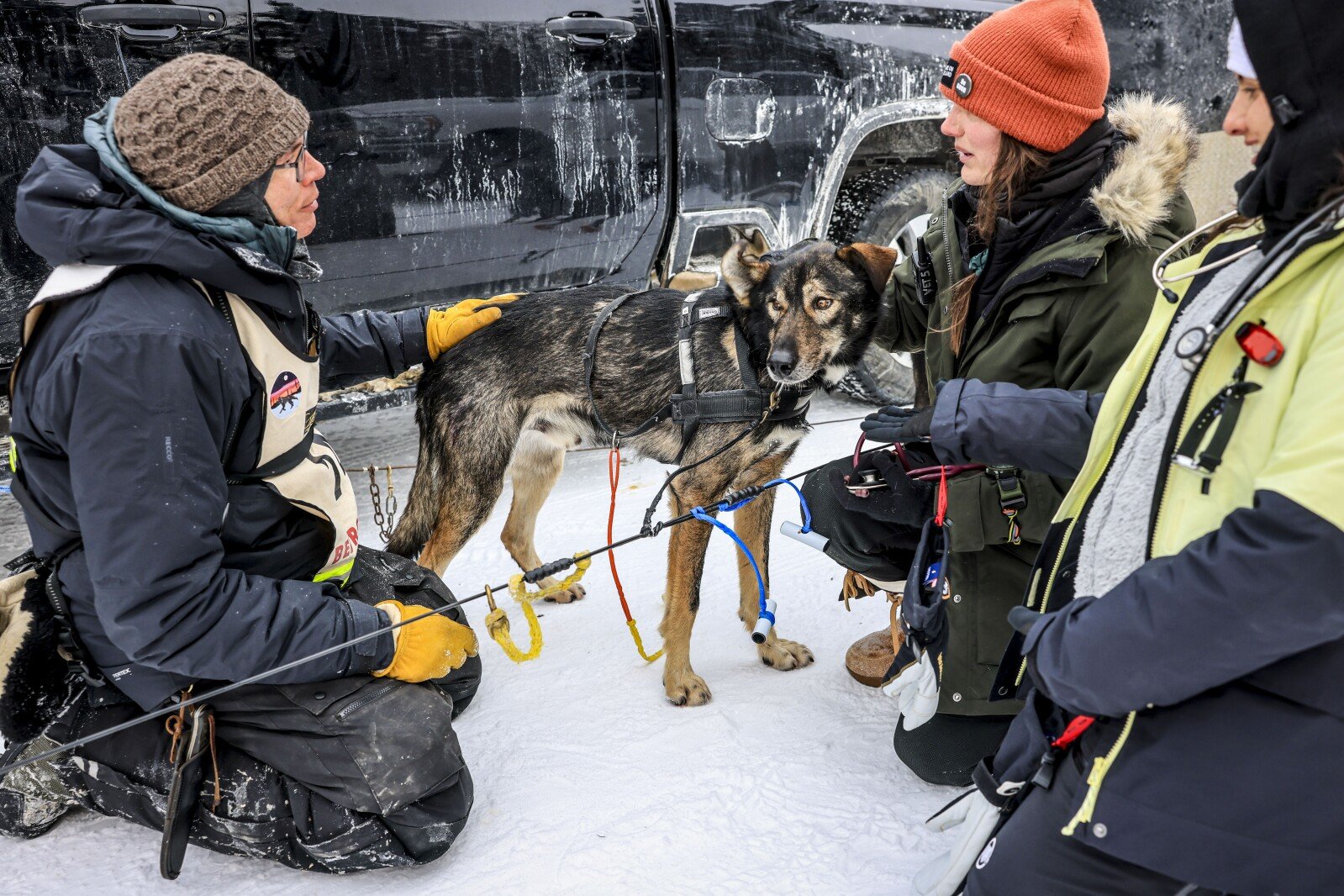
Veterinarians Jessica Esienbarth, from left, and Lauren Maghak, a fourth-year student at the Virginia-Maryland College of Veterinary Medicine, talk with musher Jesse Terry to figure out which dogs need to be examined.
Clint Austin / Duluth Media Group
If they are high-energy and their tails are wagging, that’s a good sign. But vets are also looking for signs of sore legs, diarrhea and other symptoms that might mean they need to be dropped from the team before the finish. Mushers will also flag them down if they want a dog assessed.
“We all work together to make sure dogs are the priority and the healthiest they can be,” Esienbarth said. “It’s a team system. We see all the dogs, but only for a short period of time. (The mushers) know their dogs in and out, and they can know exactly when one thing is off.”
Veterinarian Jessica Esienbarth examines Minnitaki.
Clint Austin / Duluth Media Group
Many of the veterinarians are veterans of Beargrease and other sled dog races. Patches of races they’ve volunteered at often fill the back or sleeves of their parka.
This is Esienbarth’s fourth Beargrease, and it is Kicker’s first, but he’s eager to do more.
“We’re really enthusiastic to spend time around people who are passionate about their dogs and dogs that love what they are doing,” Kicker said. “That’s why I want to keep coming back to dog sled races.”
While teams of practicing veterinarians and veterinary technicians volunteer their time to provide care, the Beargrease also provides practical learning experiences for students at the University of Minnesota.
Veterinarians Jessica Esienbarth, left, and Lauren Maghak, a fourth-year student at the Virginia-Maryland College of Veterinary Medicine, examine a sled dog.
Clint Austin / Duluth Media Group
At the start and through the Finland Checkpoint, the students shadow vets and practice physical exam skills, like taking heart rates and conducting body condition scoring.
“Just to expose them and help them kind of get practice with canine athletes,” Esienbarth said.
Lauren Maghak, a fourth-year student at the Virginia-Maryland College of Veterinary Medicine, is using this year’s race as an externship, tagging along with Esienbarth and Kicker for the entire race.
Maghak, who is interested in orthopedics, said examining working dogs, who are young and healthy, is “a really unique aspect” of the experience.
Veterinarian Jessica Esienbarth examines Minnitaki, a sled dog competing with Jesse Terry.
Clint Austin / Duluth Media Group
“It’s really cool that we’ve been able to work with dogs in such good shape,” Maghak said. “That’s not very common in a lot of veterinary specialties. Most pets are not kept in such athletic and great body conditioning.”
It’s also a lens into more rural practices where full clinics or emergency departments might not be available.
Maghak said practicing veterinary medicine on the race course forces her “to think outside the box.”
“Sometimes you have to be a little bit more crafty,” Maghak said.
Jimmy Lovrien covers environment-related issues, including mining, energy and climate, for the Duluth News Tribune. He can be reached at jlovrien@duluthnews.com or 218-723-5332.
