

A year ago, a woman with severe, unrelenting abdominal pain came to my emergency department. She knew she had gallstones and had been told that she needed surgery, but when her attacks started to escalate in frequency and severity, she did not seek medical care. Her family hadn’t met their insurance deductible, she told me, and she could not afford the surgical consult or the routine surgery.
By the time she arrived at the emergency department, my patient was critically ill — a gallstone had migrated and obstructed a downstream duct, causing a life-threatening condition called necrotizing pancreatitis. She spent two weeks in intensive care and had three surgeries. Needless to say, she met her deductible — by about a quarter-million dollars.
Several months later, my employer quietly changed nearly all of our hospital’s insurance offerings to high-deductible health plans (HDHPs), and I found myself asking my own physician to switch my medication to a drug that is less effective and less safe — but cheaper. I now feared the same bills that kept my patients away. A colleague quit her job for one with better insurance after her heart medication became prohibitively expensive on the new plan. Another shopped around for the city’s cheapest MRI, a test ordered after she lost hearing in one ear.
In our health system, even full-time physicians have $3,000 deductibles. We diagnose gallstone pancreatitis at 2 a.m. in patients who delayed care and then worry about affording our own prescriptions.
How did we get here? HDHPs are common, covering more than a third of all Americans working in the private sector with employer-sponsored insurance. These plans were first introduced in the early 2000s in an attempt to curb rising health care costs through informed consumerism. Born out of the findings of the RAND Health Insurance Experiment, economists proposed that “cost-sharing” insurance plans would decrease spending by encouraging patients to shop around, find the best price, and avoid unnecessary care — that having “skin in the game” would ultimately result in lower costs. However, the real outcome is that patients, not payers, now shoulder the burden of their medical spending, because insurance only kicks in after a substantial out-of-pocket threshold (the deductible) has been reached.
The ‘skin in the game’ approach to health care spending has failed
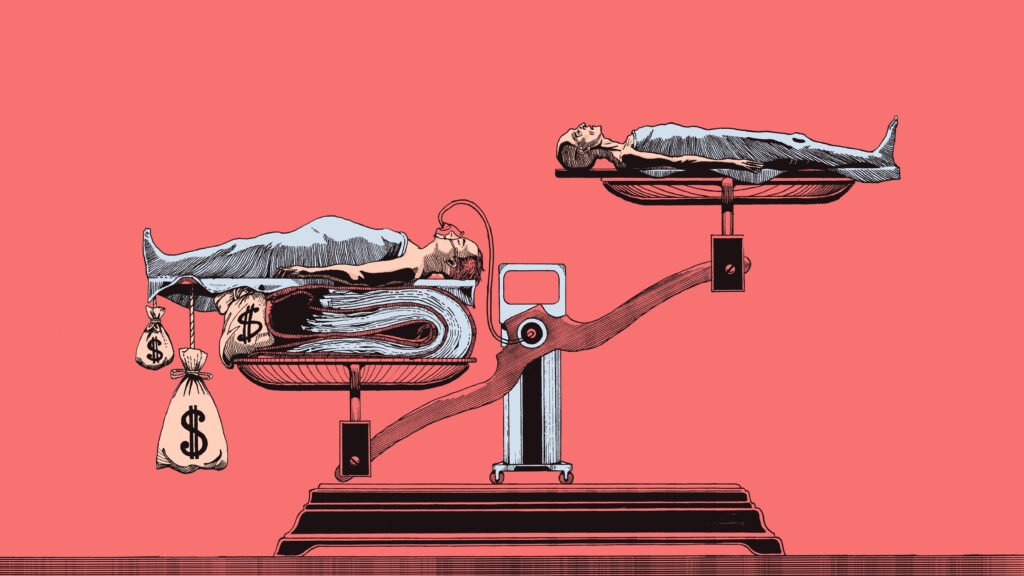
Did spending decrease with the widespread adoption of HDHPs? Well, somewhat. Patients do spend less — but not because of their savvy consumerism. Large-scale analyses in Health Affairs and JAMA show these plans reduce use of all services — preventive, chronic, and discretionary alike. Overall costs initially appear lower on paper because the spending simply disappears into delayed care and future admissions. It’s not cost containment; it’s cost deferral. What does that look like? We see patients rationing their care and postponing gallbladder surgery until it’s almost too late. Patients come in with heart failure because they couldn’t afford their blood pressure pills. Arrhythmia patients who ration their blood thinners arrive in the midst of strokes.
Ultimately, care is not cheaper — we’ve merely ensured that fewer people can access it. Now this same design is creeping into physician benefit packages. Many hospitals and medical groups have placed their own clinicians on HDHPs to save on employer premiums. It’s hard to overstate this irony. The very professionals tasked with improving outcomes are forced to prepay for their own care in the same systems they sustain. We are told to be “better consumers” while spending our days undoing the damage that this kind of consumerism causes. The tension lies in the hypocrisy. Value-based care — the framework we’re all supposed to be advancing — depends on early intervention, continuity, and prevention, and yet HDHPs punish those same behaviors. They put a financial barrier before the very encounters that generate “value.”
If the United States genuinely wants to achieve the Quintuple Aim (better care, better health, lower cost, clinician well-being, and equity), then we must align our financing with those goals. The path forward isn’t doubling down on “skin in the game” or outsourcing clinical judgment to algorithmic “value tiers” (looking at you, value-based insurance design). Frankly, both models try to solve a cost problem by rationing access, not by designing care around how illness actually develops.
A workable insurance structure starts with first-dollar coverage for all primary care, behavioral health, essential diagnostics, and evidence-based therapies for chronic disease, paired with true catastrophe protection that legitimately shields our patients from financial liability for unexpected health crises. Deductibles should be income-based (because who gets sick only in December?). Further, physician advocacy must extend beyond patient safety and staffing ratios to include how care is financed. We are both providers and consumers, and we have the data, the stories, and the unique expertise to demand better. Inside our own institutions, we should require employee health plans that reflect our clinical values. We must insist that “value-based care” start with value-based coverage, because the truth is undeniable; HDHPs are structurally incoherent, and physicians now live the same rationing harms we see in patients.
In my case, I toughed out the inferior drug for a year, and then switched to a more expensive insurance plan at open enrollment — one that covered the original medicine my doctor had prescribed. But I know not everyone could afford that decision.
I don’t claim to have all the answers, but I do know one thing. In any other field, a business model that succeeds only when consumers avoid using the service they’ve paid for would raise serious questions about its sustainability and ethics. If our insurance model lacks an intelligible theory of health, we shouldn’t be shocked when our patients are sicker.
Amy Caggiula is board-certified in emergency medicine and is an assistant professor of emergency medicine at the George Washington University School of Medicine and Health Sciences.
