

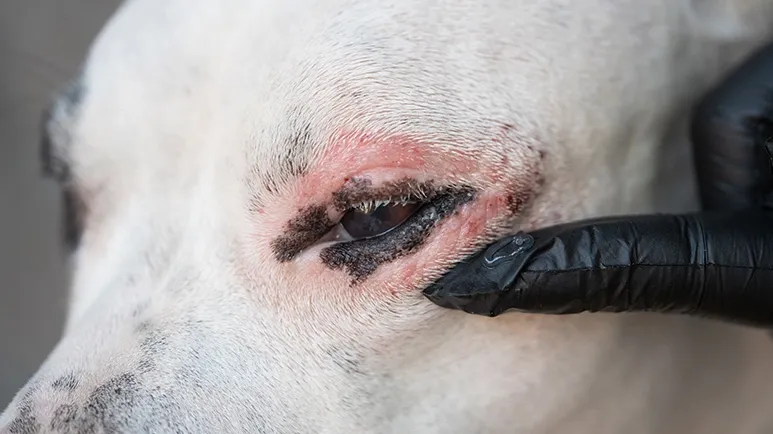
This skin condition can look like a stubborn allergy, a fungal infection, or even just chronically dry skin, but the real culprit might stem from how your dog’s body absorbs and utilizes an essential mineral — find out what it is.
Advertisement
Join the Bark & Whiskers™ Family
Sign up today for our FREE newsletter, packed with expert advice and insider tips to keep your beloved pet in tip-top shape.
View our Privacy Policy and Terms of Service.
STORY AT-A-GLANCE
- Zinc-responsive dermatosis is an uncommon skin disease in dogs caused by impaired zinc absorption or diets that interfere with zinc uptake
- The common signs include symmetric crusting and hair loss around the eyes, mouth, and pressure points, often with thickened paw pads and a dull, dry coat
- Nordic breeds like Siberian huskies and Alaskan malamutes are prone to it because of an inherited absorption defect, while fast-growing large-breed puppies can develop it from diets that hinder zinc uptake
- Blood tests for zinc levels are often unreliable in dogs, so veterinarians confirm the disease through skin biopsy and clinical pattern recognition
- Many dogs show noticeable improvement within four to six weeks of dietary correction or targeted zinc supplementation, though hereditary cases require lifelong support
Skin problems are one of the most common reasons dogs end up at the veterinary clinic,1 and when those problems linger for months without fully improving, most pet parents arrive at the conclusion that they are allergies. Sometimes that assumption is right. But in some dogs, chronic skin disease can develop for an entirely different reason — not an allergen, a parasite, or even an infection in the usual sense.
The cause lies in the body’s ability to absorb and use an essential mineral: zinc. The condition is called zinc-responsive dermatosis, and many pet parents have never heard of it.2 If your dog has been struggling with skin issues and the usual approaches have not worked, this is one possibility worth discussing with your veterinarian.
A Mineral That Quietly Holds Everything Together
Zinc is a trace mineral, but its role inside the body is anything but minor. It is a cofactor of more than 300 enzymes that drive everyday biology, and it plays a direct role in immune function, thyroid signaling, and the rapid cell turnover that keeps skin, hair, paw pads, and the intestinal lining healthy.2
The skin has one of the highest zinc demands in the body, as it constantly renews itself.4 Each new generation of cells needs zinc to mature properly, organize into protective layers, and form the skin barrier that holds moisture in and irritants, microbes, and allergens out.5 When zinc availability drops, the effects can begin showing up in your dog’s skin through symptoms such as:6,7,8
- Symmetric crusting around the eyes, mouth, and ears
- Similar crusty lesions on areas where skin transitions to mucous membranes, such as the lips, vulva, prepuce, scrotum, and anus
- Thickened, cracked, leathery paw pads that may make walking uncomfortable
- A dull, dry coat, often paired with itchiness from secondary bacterial or yeast infections that take hold once the skin barrier is compromised
Beyond the skin, inadequate zinc availability may also cause poor appetite, lethargy, diarrhea, frequent or recurring infections, reproductive problems, and stunted growth in puppies.9
Why Some Dogs Cannot Get Enough Zinc, Even from a Complete Diet
Most dogs get plenty of zinc from a high-quality, balanced diet, and outright dietary zinc deficiency is rare. The dogs who struggle with this condition usually have either a genetic limitation in how they absorb the mineral or a diet that delivers zinc alongside ingredients that block it from reaching the bloodstream. Veterinarians typically describe two distinct patterns:10,11,12
- The hereditary form — This appears most often in Nordic breeds such as Siberian huskies and Alaskan malamutes, though it has occasionally been reported in Doberman pinschers and Great Danes. These dogs inherit a reduced ability to absorb zinc through the intestinal lining, which means even a well-balanced diet may not meet their physiological needs. Signs typically appear in early adulthood, often around 3 years of age (although it can manifest later in life), and tend to flare during periods of stress, illness, or estrus.
- The dietary form — This form typically affects rapidly growing large-breed puppies such as Great Danes, German shepherds, Labrador retrievers, standard poodles, and Doberman pinschers. It develops when the diet is low in zinc or more commonly when the diet contains compounds that interfere with zinc absorption, including high levels of plant phytates or excessive mineral supplementation, especially with calcium. Elevated iron levels in drinking water may also reduce zinc absorption through the gastrointestinal tract.
How Veterinarians Diagnose This Condition
Several conditions look very similar to zinc-responsive dermatosis, and chasing the wrong diagnosis can cost months of comfort. You might expect that measuring zinc in the blood or hair would settle the question quickly, but those tests are notoriously unreliable in dogs. Sample contamination, daily fluctuations, and lab variability all make the numbers difficult to interpret.13
Instead, your veterinarian will usually start as they would for any persistent skin problem — by ruling out conditions that resemble zinc-responsive dermatosis but are not. Demodex mites, ringworm, bacterial pyoderma, allergies, autoimmune disease, and a more concerning condition called hepatocutaneous syndrome can all produce overlapping clinical pictures.14 The diagnostic process usually includes:15,16,17
- A thorough history covering breed, age of onset, diet, supplements, and recent stressors
- Physical examination of lesion distribution and pattern
- Skin scrapes and cytology to assess for parasites and infection
- Fungal cultures when ringworm is on the differential list
- Skin biopsy from a crusted area
However, it is worth noting that recognizing signs of zinc-responsive dermatosis does not mean zinc supplements should be given without appropriate dosing. Excess zinc can cause gastrointestinal upset and, at sufficiently high levels, even contribute to hemolytic anemia. Supplementation should be part of a treatment plan developed with your veterinarian.18
Helping Your Dog’s Skin Recover
The good news is that zinc-responsive dermatosis often improves substantially once the underlying problem is identified and addressed properly. Many dogs begin showing noticeable improvement within four to six weeks of starting treatment. Strategies may include:19,20,21
- Address the diet first — In dogs whose condition is linked to dietary factors, improving the nutritional foundation is often the first step. Feeding a nutritionally balanced, species-appropriate diet that provides adequate bioavailable zinc, while avoiding unnecessary calcium supplementation or foods high in phytates, may help restore normal zinc status and improve skin health over time. Foods naturally rich in zinc include lightly cooked organ meats, sardines, eggs, and small amounts of cooked oysters.
- Supplement with zinc when appropriate — Veterinarians may recommend forms such as zinc methionine, zinc gluconate, or zinc sulfate depending on the individual case, tolerance, and response to treatment. Because zinc dosing should be balanced carefully to avoid gastrointestinal irritation and mineral imbalances, dosing should always be guided and monitored by your veterinarian.
- Consider supportive omega-3 fats — EPA and DHA from fish or krill oil are sometimes added to support skin health in dogs.22 Ask your veterinarian whether they make sense for your dog and at what dose.
- Reduce stressors when you can — Because stress, heat cycles, and seasonal changes can trigger flare-ups, simple environmental adjustments like predictable routines, calmer spaces, and gentler grooming may help lighten the load on a vulnerable system.
A Skin Issue Worth Looking at More Closely
Chronic skin problems can be frustrating for both dogs and the people caring for them, especially because the underlying cause may not always be as straightforward as it first appears. Zinc-responsive dermatosis may be uncommon, but it is a reminder that some skin conditions are tied not just to irritation on the surface, but to deeper problems involving nutrition and mineral absorption.
If your dog fits the profile — a Nordic breed, a large-breed puppy on a complicated diet, or simply a dog whose skin issues never quite line up with what you have been treating — it is worth raising the possibility with your veterinarian. With the right treatment plan, dogs with this condition are able to regain healthier skin, a stronger coat, and better day-to-day comfort.
- 1 PetMD, April 29, 2024
- 2,6,11,14,16,20 Clinician’s Brief, Zinc-Responsive Dermatosis in Dogs
- 3 Animal Bioscience, Role of Dietary Zinc as a Nutritional Immunomodulator
- 4 Nutrients. 2018 Feb 11;10(2):199
- 5 Animals (Basel). 2021 Apr 1;11(4):978
- 7,9,12,13,17,21 VCA Hospitals, Zinc-Responsive Dermatosis in Dogs
- 8,10,15,19 Vetster, How to Treat and Prevent Zinc Deficiency in Dogs
- 18 Vetster, Zinc Poisoning in Dogs
- 22 Vet Sci. 2020 Apr 3;7(2):38
In this free guide, you’ll discover:
-
How your pet’s biology influences their nutritional needs -
Why conventional feeding advice often falls short -
Practical ways to choose better food for your dog or cat
View our Privacy Policy and Terms of Service.
