

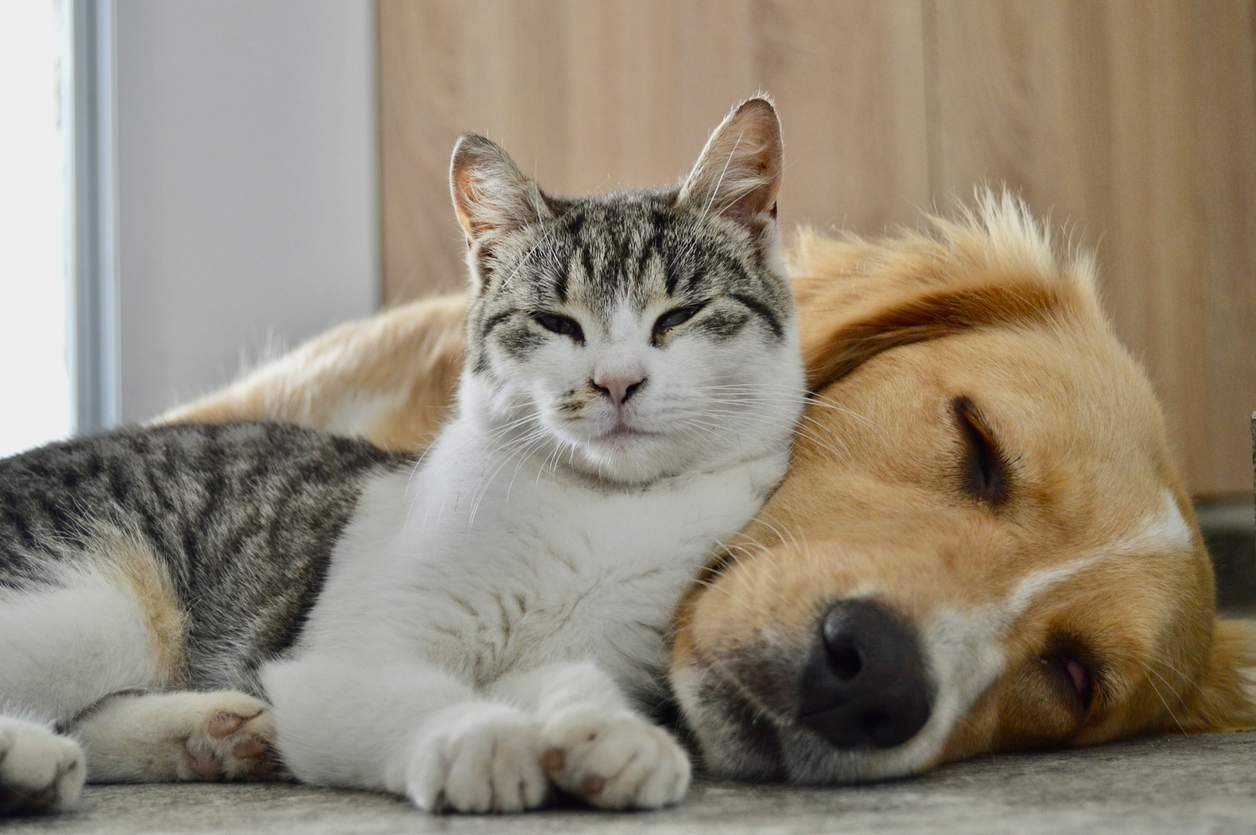
Do your cat and dog not get along? Maybe your cat hides from your dog because he chases him. Or perhaps your dog tries to get some extra calories in by stealing your cat’s food? Fortunately, most dogs and cats can learn to peacefully coexist if you manage their interactions. In this blog, we will discuss how to help your dog and cat get along. Which will help them develop a positive relationship. Let’s start off by discussing how to manage your dog.
Puppy proofing the home
It’s important that you don’t let your dog wander freely around the house. Not only do free range puppies tend to get into mischief like chewing up paper towels, and have potty training challenges. But your cat will need a safe place to rest without being bothered by your dog.
Your dog may chase the cat because it’s a fun game. But it can quickly become a source of stress for your cat. This could lead to your cat avoiding parts of the home, including where the litter box or food bowl are.
You can help prevent this by limiting your dog’s access to rooms by using pet gates or baby gates. For more help, you can check out our blog on “Puppy proofing and how to secure your home”.
Now that we have talked about the important of setting boundaries, let’s discuss how to create a safe area for your cat.
Create safe spaces for your cat
Cats are naturally curious, and may enjoy investigating what your dog is up to. They also need safe areas where they can relax and observe from a distance.
Chasing is one of the most common sources of stress for cats living with dogs. So how can you provide your cat with a safe space without the fear of being chased? You can set up a cat tree, where your cat can have a safe vantage point to rest and observe.
You can use mealtimes to help develop a positive relationship
By sharing mealtimes with your cat and dog, you can provide them with a daily routine together. This will help with building a positive association with each other.
You should make sure that your dog isn’t able to take your cat’s food. You can separate your cat and dog’s food through a pet gate or feeding your cat at an elevation such as in a cat tree.
If you notice that either your cat or dog is stressed during meals or guarding their food, it is best that you feed them separately. You can feed them both treats when they are being calm around each other. Which will help encourage your dog not to chase your cat.
Learning to read your cat’s signals
Cats can show their curiosity and excitement through running, gentle swatting and vocalizing, which could look like your cat is stressed. One way to check if your cat is stressed is to see if your cat is hissing. If your cat is hissing, then it’s usually a sign they want to get away from your dog. It may also look like, your cat is running away, but they can could then quickly dash back near your dog. This is a sign that your cat is playing a game.
We are here to help
It may take time for your cat to get used to your dog, and until then you should ensure that every interaction is supervised. Some breeds, like Blue Heelers and Border Collies, have strong prey drives and may be very interested in bothering your cat.
Beyond the Dog Tampa Bay has helped many dogs and cats to peacefully coexist in their homes. We also specialize in addressing dog chasing and aggression towards cats. If you have any questions, you can schedule a free consultation with our Pet Behavior Team to discuss your training goals and receive a personalized recommendation.
We use scientifically proven training methods, backed by over 20 years of hands-on experience. Beyond the Dog Tampa Bay is led by our co-founders, Dr. Echterling-Savage, a Certified Applied Animal Behaviorist (CAAB) and Board Certified Behavior Analyst (BCBA), and Sean Savage, a Certified Dog Behavior Consultant (CDBC) and Certified Professional Dog Trainer-Knowledge Assessed (CPDT-KA).
