

STORY AT-A-GLANCE
- With a flavor profile that tastes like a cross between an apple and a potato, jicama can be a good addition to your pet’s list of favorite treats
- There’s growing interest in the study of jicama because of its beneficial phytochemicals
- Studies have discovered that jicama contains anti-inflammatory and immune-modulating compounds
- Jicama is rich in inulin fiber, which acts as a prebiotic, helping boost good bacteria in the gut while simultaneously inhibiting pathogenic strains
- When feeding jicama to pets, only the white flesh of the tuber is appropriate. Other parts of the plant contain rotenone, a naturally occurring insecticide, and should be discarded.
Editor’s Note: This article is a reprint. It was originally published August 31, 2023.
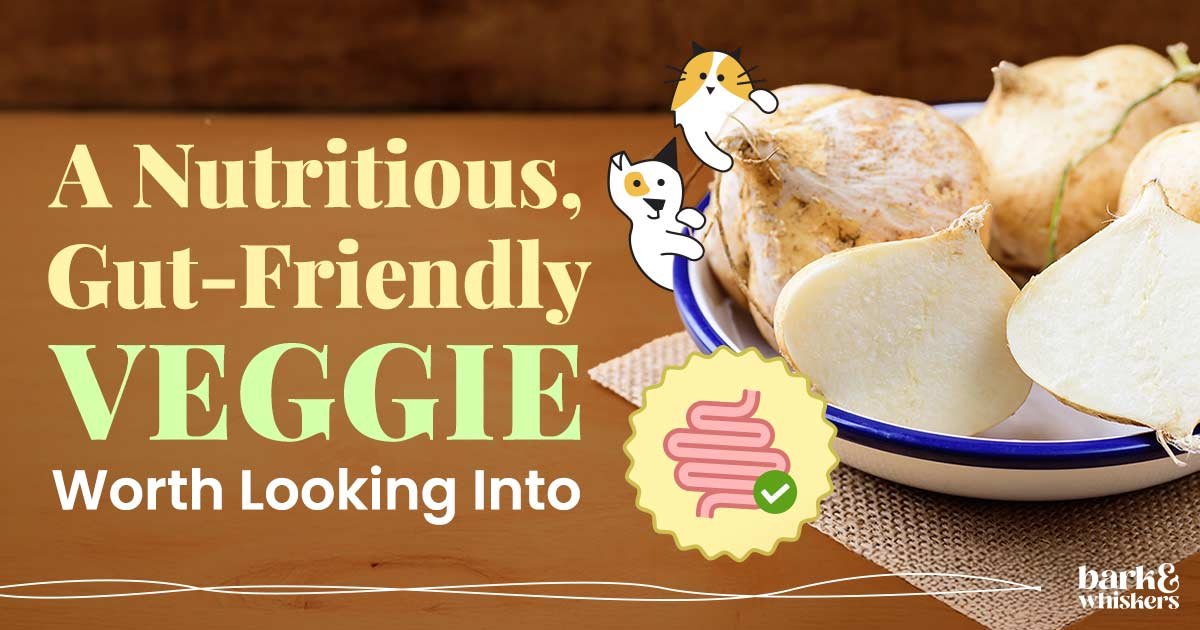
Introducing new vegetables to your pet can be an engaging activity. Figuring out what they like and don’t like can deepen your bond with them, and one vegetable you likely haven’t looked into yet is jicama (Pachyrhizus erosus). With a flavor profile that tastes like a cross between an apple and a potato, it can be a good addition to your pet’s list of favorite treats.
The great thing about jicama is that it can be made even better through fermentation. However, there are some things you need to know first. Read on to find out how you can properly utilize this vegetable in your pet’s diet.
Jicama Fun Fact
Jicama is pronounced “HEE-ka-ma.”1 It’s a Spanish word derived from the original Aztec word “xicama,” which means “edible storage root.”2,3
Jicama’s Bioactive Compounds Have Different Benefits
“Jicama has notable properties that should make it a mainstay in your pet’s diet. It has fiber that can help nourish probiotics in the gut and other nutrients that may help fight inflammation and promote overall health.”
There’s growing interest in the study of jicama because of its beneficial phytochemicals. According to a 2022 analysis, jicama contains immune-modulating properties. Specifically, researchers found that it boosted IL-10, an anti-inflammatory cytokine that may help prevent the damaging effects of macrophages. The same study also noted that jicama helped boost the immunoglobulin population in mice.4
In another study, researchers determined the phytoestrogenic compounds present in jicama help strengthen bone density. They discovered that mice fed extracts made from jicama tubers had better bone health, including improved bone density and mineral content. Test mice also had longer femurs, which meant better weight support.5
Jicama Is High in Prebiotic Fiber and Vitamin C
Jicama is also noted for its inulin content. Inulin works as a prebiotic, which means that it nourishes your pet’s gut microbiome.6 To give you a better idea of jicama’s potential, a mice study published in Experimental Gerontology noted that it helped inhibit the growth of pathogenic bacteria, particularly E. coli and Pseudomonas aeruginosa.
The same study also mentioned that inulin helped increase the presence of probiotics such as Bifidobacterium and lactobacillus, which, in turn, helped produce more short-chain fatty acids via fermentation in the gut.7 These fatty acids serve as energy and may even influence gut-brain communication.8
Inulin may help in other areas of health as well. In a study published in 2021, test mice given inulin had better glucose and lipid metabolism.9 The short-chain fatty acids produced through inulin may help manage inflammation as well, according to an article published in Scientific Reports.10
Jicama also contains vitamin C, with 1.64 grams for every tablespoon.11 Although dogs and cats can produce their own vitamin C, obtaining supplementary amounts of this nutrient from their diet can also support their health, as research suggests it plays different important roles in their body. For example, a study published in the Canadian Journal of Veterinary Research noted that vitamin C is an important cofactor for collagen biosynthesis and has powerful antioxidant capabilities.12 Vitamin C may also help boost skin health,13 as well as immune system function.14
Did You Know?
From Mexico, Spaniards brought jicama to their colonies in Asia. There, it became a popular substitute for bamboo shoots and water chestnuts.15
Preparing and Offering Jicama to Your Pet
Misinformation about many healthy fruits, vegetables, nuts and seeds abounds on the internet. This is because websites have labeled all risks (such as the risk of overconsumption causing gastrointestinal issues, or choking on too large of pieces or pits) as “toxicities,” which isn’t true but has managed to confuse millions of pet lovers, nonetheless.
Jicama is safe for pets, but make sure to only feed them the white flesh from the actual tuber.16 Other parts of the plant, such as the leaves and seeds, contain a naturally occurring insecticide called rotenone. If consumed, rotenone can cause vomiting, muscle tremors and rapid heartbeat.17 To prepare jicama for safe consumption, follow these steps:18
- Cut off the roots — Place the jicama on a cutting board. Using a sharp knife, remove all the stray roots.
- Rinse the dirt — Wash the jicama under running water and use your fingers to remove all dirt.
- Peel the skin — Use a vegetable peeler and your fingers or paring knife. Sometimes, a combination of all three may be the best approach.
- Slice the jicama — Once you’ve peeled the jicama, slice it into small, bite-sized pieces to avoid choking risks.
Another thing to note is that jicama, or any other treat or “healthy extra,” should only comprise a small percentage of your pet’s nutritionally optimal, species-specific diet. Jicama can be served raw or lightly cooked. You can mince a few slices of it and use that as food toppers or chop it into bite-sized pieces and use as training treats. You can also puree it and spread it on a lick mat or stuff it into an interactive toy.
Store any jicama you have in a cool, dry place. Done properly, it can last one to two months. Moisture may cause mold to grow, which can ruin your inventory and, thus, waste your money. While it may be tempting to place jicama in the refrigerator, this is inadvisable. Cold temperatures can damage the flesh of the vegetable.19
Consider Fermenting Jicama
Jicama can be fermented through homemade techniques,20 improving its health benefits, as fermented vegetables are optimally digestible for dogs and cats. Furthermore, they seed the gut with more probiotics, as well as act as chelators and detoxifiers.
If your pet dives in right away when offered fermented vegetables, that’s great! For pets who are not open to this idea yet, start by mixing a bland veggie, such as a small amount of minced zucchini, with their food. It’s an efficient way of adding more nutrients without upping caloric intake.
Top Jicama Producers
Mexico provides much of the jicama sold in the U.S., and they’re grown in three locations. The first is in Guanajuato, which harvests during autumn. The second is in Morelos, with a winter harvest. The last is in Nayarit, which has winter and spring harvests.21
Sustainability of the Jicama Industry
You don’t have to worry about sustainability issues when it comes to buying jicama. According to a report from HEALabel, it has a relatively low water footprint. Only 387 liters of water are required to produce a kilogram of harvest. Carbon footprint is low as well, with 0.4 kilograms of CO2e, which is the equivalent of a car driving 1.5 kilometers.22
The jicama industry in the U.S. is very small and located in Texas and Florida. Sometimes, these specialized growers may appear in farmers markets in California. This makes it hard to look for certified organic jicamas, so you’ll have to exert some effort if you choose this route.23 If you’re not able to find organic varieties near you, that’s fine. Just make sure the jicamas you’re buying are washed and cleaned thoroughly before consumption.
- 1,17 Very Well Fit, June 22, 2023
- 2,23 FoodPrint, Jicama
- 3 Eden Seeds, Growing Jicama
- 4 Antioxidants (Basel). 2021 Dec 27;11(1):58, Immune Modulation
- 5 Antioxidants (Basel). 2021 Dec 27;11(1):58, Anti-Osteoporosis Potential
- 6 Cleveland Clinic, March 14, 2022
- 7 Front. Microbiomes, 30 November 2022 Sec. Nutrition, Metabolism and the Microbiome Volume 1 – 2022, Abstract
- 8 Front. Endocrinol., 31 January 2020 Sec. Neuroendocrine Science Volume 11 – 2020, SCFAs and the Brain
- 9 Diabetology & Metabolic Syndrome, Volume 13, Article number: 150 (2021), Abstract
- 10 Scientific Reports volume 10, Article number: 978 (2020), Abstract
- 11 USDA, FoodData Central, Yambean (Jicama), Raw
- 12 Can J Vet Res. 2006 Oct;70(4):305–307, Abstract
- 13 Nutrients. 2017 Aug 12;9(8):866, Abstract
- 14 Nutrients 2017 Nov 3;9(11):1211, Abstract
- 15,16 Produce Blue Book, Jicama Market Summary
- 18 MasterClass, October 22, 2021
- 19,21 University of Hawaii, Jicama, Yam Bean, Page 71
- 20 CulturedFoodLife.com, Jicama If You’re Sicka-ma
- 22 ShopLogic, January 2, 2025
In this free guide, you’ll discover:
-
How your pet’s biology influences their nutritional needs -
Why conventional feeding advice often falls short -
Practical ways to choose better food for your dog or cat
View our Privacy Policy and Terms of Service.
