

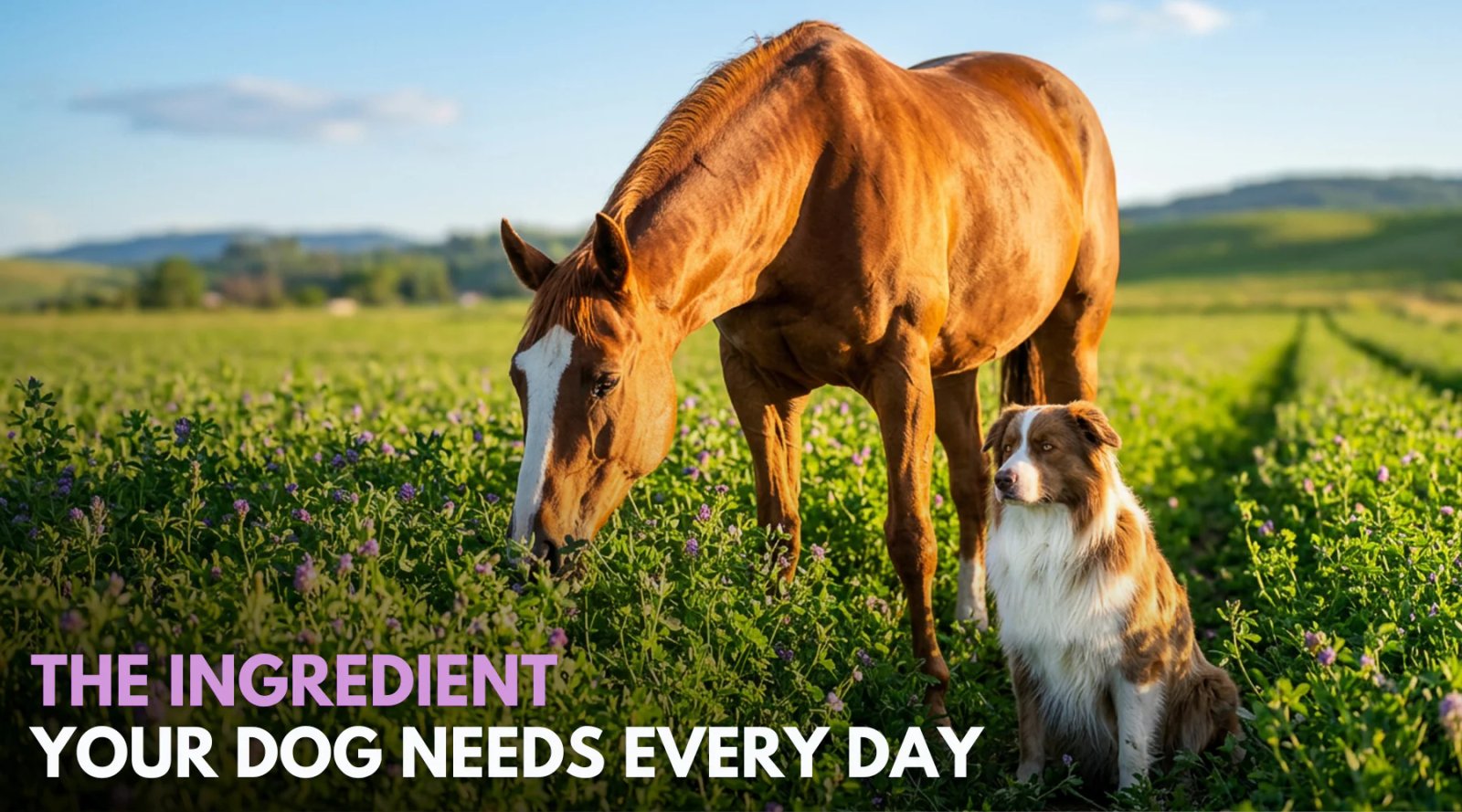
I have a confession to make.
I have been mispronouncing one word my entire life — and it happens to be the name of one of the most important ingredients in SoulFood.
In Czech, my first language, we say alfa-alfa. Short, clean, symmetrical. In English it becomes alfalfa, and after decades of living in Canada, my tongue still can’t fully commit to one version. Some days it comes out right. Most days it doesn’t. I’ve made peace with it.
Because the word doesn’t matter. What matters is what this plant does. And what it has meant to me — for reasons that go far deeper than nutrition.
The Horse Behind the Name
Every time I say alfa-alfa — or alfalfa, whichever comes out first — I think of a horse.
Her name was A-L-F-A.
She was my best friend during my teenage years, you know how we feel about our animal friends. Unfortunately, she had chronic tendonitis, and I watched her limp with a helplessness that sat in my chest for years. She was not owned by my family, but by a state-run stable, which made protecting her much more difficult. I also didn’t know enough to help her, because I didn’t have the knowledge I have now.
That helplessness was a big reason why I became a veterinarian.
Years later, when I got my first dog Skai, he looked just like her — the coloring, the white blaze on the nose, the spirit, the way he loved to run and jump obstacles with pure joy, just the way Alfa did on her best days. I started to play with the idea that perhaps, Alfa came back to me, this time in his body. Of course, I couldn’t know but the idea was comforting.
Also, knowing that this time, I could be there for Skai and perhaps Alfa, as a vet. And every time I hear the word alfalfa, I think of Alfa, Skai…. Perhaps a rather eccentric connection, but it warms my heart.
The Plant That Goes Deeper
Alfalfa (Medicago sativa) has been called the father of all foods. Farmers and livestock herders have known for centuries that it restores what depleted land loses. Animals who have access to alfalfa instinctively seek it out — and there is a very, very good reason why.
While most modern food crops have root systems that only reach a few inches into depleted topsoil, alfalfa’s taproot can extend 20 to 30 feet underground! Imagine – 30 feet!
The roots reach deep subsoil — layers that farming has never touched, never depleted, and never chemically fertilized.
What comes back up through those roots is extraordinary:
- Vitamin K1 — essential for blood clotting, bone mineralization, and calcium metabolism in joints
- Vitamin D — supports calcium absorption and immune function
- Vitamin E — a fat-soluble antioxidant that protects cells from oxidative damage
- Beta-carotene — the natural plant form of vitamin A, supporting eye health, skin integrity, and immune response
- Chlorophyll — the green pigment that research describes as a natural daily detoxifier, helping bind and clear certain toxins in the digestive tract before they are absorbed
- Prebiotic fiber — feeds and diversifies the beneficial bacteria living in your dog’s gut
- Calcium, magnesium, and potassium — drawn from deep mineral-rich earth layers untouched by modern agriculture
- 18 amino acids — including tryptophan, the precursor to serotonin that supports your dog’s sense of calm and emotional resilience
This is why alfalfa is the highest-dose wholesome ingredient in SoulFood — at 4,500 mg per serving. Not for label appeal. Because at that dose, in a fermented form, it makes a genuine difference across multiple body systems at once.
What the Research Shows
In 2024, researchers published a controlled study on raccoon dogs — a canid species — fed diets containing different levels of alfalfa meal for 60 days.
At 5% dietary inclusion, the results were clear:
- Serum antioxidant capacity significantly increased — specifically SOD (superoxide dismutase), one of the body’s most important protective enzymes
- Oxidative stress markers (MDA) significantly decreased — meaning less cellular damage
- Serum urea decreased — a positive signal for healthy kidney function and protein metabolism
- No negative effect on growth or nutrient digestibility
In plain language: moderate alfalfa supplementation made the animals healthier at a cellular level. It protected them from the inside out. And it did so without any trade-offs at the doses used.
This confirms what traditional animal husbandry has always known — and what I have observed clinically for over three decades.
Why Fermentation Changes Everything
Here is what no other supplement brand does — and what we refuse skip — dual stage fermentation.
Plants protect their seeds and nutrients with anti-nutrient compounds — particularly phytic acid and saponins. These compounds can bind minerals, limit vitamin absorption. For a cow with several stomachs and grazing all day, this is not a problem. For our dogs taking a supplement once daily, it means a significant portion of what is on the label may pass through largely unused.
Fermentation is the key that changes this completely.
Through our proprietary dual-stage fermentation process, beneficial yeast and probiotic bacteria break down alfalfa’s anti-nutrients before the supplement ever reaches your dog’s bowl. Vitamins are converted into their most bioavailable active forms. Beneficial postbiotic compounds — things your dog’s body genuinely uses — are created naturally during the process itself.
The result: A supplement with 7 to 10 times greater bioavailability compared to an unfermented equivalent. Research proves this.
And because the fermentation has already done the digestive work, SoulFood is gentle on the stomach — even for dogs with sensitive digestion, puppies, and seniors. This is not a small distinction. It is the difference between a supplement that looks good on paper and one that actually makes a difference.
How Alfalfa Helps Your Dog
-
Gut health
Alfalfa’s prebiotic fibre feeds the beneficial bacteria in your dog’s digestive tract. A 2024 canid study confirmed that alfalfa supplementation can increase the richness and diversity of intestinal microbiota. -
Gentle daily detox
Alfalfa’s chlorophyll supports the liver and lymphatic system by helping bind and clear toxins in the gut each day. Combined with dandelion root, turmeric, and parsley in SoulFood, this is a quiet, continuous detox support system — not a dramatic cleanse, but steady daily maintenance the way the body was designed to work. -
Urinary and pH support
Alfalfa has a natural mild alkalizing effect on urine, helping support a healthy urinary pH. This is why SoulFood lists “supports healthy pH balance” as one of its benefits — and for dogs prone to urinary discomfort or overly acidic urine, this is quietly valuable support every single day. -
Joints and bones
Vitamin K1 from alfalfa supports the mineralization of bone and helps regulate how calcium is deposited in joints. Anti-inflammatory flavonoids reduce the low-grade systemic inflammation that leads to stiffness and discomfort over time. For senior dogs, this daily background support is one of the most important investments you can make. -
Antioxidant protection
The SOD-boosting, MDA-lowering effect confirmed in the 2024 research means alfalfa is actively protecting your dog’s cells from oxidative damage — the same cellular damage that accelerates aging and contributes to chronic disease.
A Few Things Worth Clarifying
“Isn’t alfalfa a legume — does it cause DCM (dilated cardiomyopathy)?”
The DCM concern raised by the FDA centered on peas, lentils, and chickpeas has now been debunked. Also there is no evidence connecting supplemental alfalfa to DCM.
“Can I use grocery store sprouts instead?”
Fresh alfalfa sprouts are a lovely food topper and safe in small amounts. But they didn’t grow in soil to absorb nutrients or contain chlorophyll.
One important note: never feed alfalfa seeds — they contain a compound called L-canavanine that is harmful to dogs. Sprouts are food. SoulFood’s fermented alfalfa is nutrition.
“What about phytoestrogens?”
Alfalfa contains mild phytoestrogenic compounds. The research that raises concern about phytoestrogens and canine endocrine function focused on soy isoflavones at dietary levels far exceeding what you would find in supplemental alfalfa. At SoulFood’s supplemental dose, there is no evidence of hormonal disruption for typical dogs.
How to Get Started
SoulFood is simple to use. Add it to any food — raw, cooked, or kibble — just before serving:
- Up to 10 kg (22 lbs): ½ tsp daily
- 11–25 kg (23–55 lbs): ¾ tsp daily
- 26–50 kg (56–110 lbs): 1 tsp daily
- Over 50 kg (110+ lbs): 1½ tsp daily
For complete foundational nutrition, pair SoulFood with GreenMin (minerals), FeelGood Omega (essential fatty acids), and GutSense (probiotics). Together, these four supplements address every major nutritional gap that modern food cannot fill on its own.
The Investment That Only Gets Better With Time
Whole-food fermented nutrition does not produce overnight transformations. It builds a foundation — quietly, daily, compounding over months and years.
Most guardians begin noticing improvements in coat quality, digestion consistency, and overall energy within 4 to 8 weeks. The deeper results often only become visible in retrospect — at year 10 or 12, when your dog is still running to meet you at the door, still curious about the world, still full of the vitality that tells you something is genuinely, quietly right.
