

STORY AT-A-GLANCE
- If you’re a new kitten parent, it’s important to offer the right nutrition to get her off to a strong start in life
- Feeding a newborn, orphaned kitten requires either an agreeable substitute mother cat or a special kitten formula and lots of your time and attention
- Weaning your kitten, if necessary, requires gradually transitioning from kitten formula to a biologically appropriate solid food diet
- Avoiding common feeding mistakes will ensure your cat is well-nourished and in good physical condition throughout her life
- Cats in multi-cat households should be fed separately. This gives you the ability to precisely control the amount of food each kitty is served, and lets you know immediately if someone’s appetite drops off or picks up noticeably
Editor’s Note: This article is a reprint. It was originally published February 12, 2019.
If you’ve just welcomed a new kitten to the family and you’re like most new pet parents, you probably have questions about how to give your little fluffball the best start in life. Since what you feed your new furry baby will be the foundation of her health and well-being throughout her life, it’s important to make good choices right from the start. Choices about the best way to nourish your kitten will depend on how old she is when you bring her home.
Feeding a Newborn Kitten
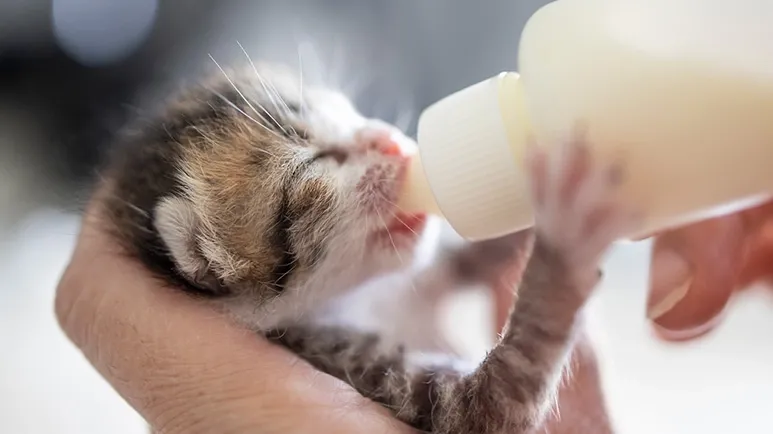
Newborn kittens are entirely dependent on their mothers, especially for food. In terms of nourishment, the very best alternative is another mother cat who will accept and feed your motherless babe. If there are no foster mothers available, a milk replacer is your only other option.
Cow’s milk isn’t a good choice. Not only is it non-nutritious, it also causes diarrhea, which is extremely dangerous for very young kittens. What’s needed is either a commercial kitten formula available at pet stores or online (e.g., KMR), or a homemade kitten formula recipe. In an emergency, you can mix:
- 3 ounces of condensed milk
- 3 ounces of water
- 4 ounces of plain yogurt (not low-fat)
- 3 to 4 egg yolks (no whites)
Raw, unpasteurized goat’s milk in a pinch also has good success. Whether you use a commercial or homemade formula, only make enough for one day’s feeding and store it in the refrigerator. To actually get the formula into your tiny newborn’s mouth, you’ll need a pet nursing kit that includes a bottle, several nipples and a cleaning brush. Wash and dry the bottles and nipples thoroughly between feedings.
Warm the kitten milk replacer in a pan of water to 98 degrees F to 100 degrees F before feeding, and mix well to decrease the risk of hot spots of formula. Wash your hands thoroughly with warm water and soap before and after each feeding. Kittens should be fed on their stomachs on a towel or other soft fabric they can knead as though they’re nursing.
Open kitty’s mouth gently with your fingertip and slip the nipple into her mouth. It’s extremely important to prevent air from getting in her stomach, so hold the bottle at a 45-degree angle at all times, and pull on it ever so slightly to encourage her to suck.
If she aspirates formula into her lungs and begins coughing or choking, immediately hold her upside down (gently and while supporting her body) until the choking subsides. If you discover she isn’t strong enough to suckle, you should seek veterinary assistance immediately.
How Much and How Often to Feed
Read formula package instructions for recommended feeding amounts and feedings per day. A kitten needs approximately 8 ccs of formula per ounce of body weight per day. The number of daily feedings depends on the age of the kitty.
When your kitten is full, she’ll often have bubbles around her mouth and a larger belly. After each feeding, hold her upright against your shoulder and rub her very softly on the back to burp her. Many kittens do better with very light massage. Take care not to overfeed, as this can cause diarrhea and other problems.
Kittens should be weighed daily to calculate the amount of formula they’ll need. As a general rule, kittens under 1 week should be fed every 2 to 3 hours; at 2 weeks, they can be fed every 4 to 6 hours; after 3 weeks and until weaned, they should be fed every 6 to 8 hours.
Divide your kitten’s required daily intake by the number of required daily feedings to determine how much she should eat at each feeding. Newborn kittens should gain about 1/2 ounce every day or 4 ounces a week. Weigh yours at the same time every day. No weight gain or lost weight that doesn’t correct itself in 24 hours requires a visit to the veterinarian.
Weaning Your Kitten
At about 2 to 3 weeks, when their eyes are fully open and they’re moving around well on their own, many (but not all) kittens can start a slow transition to solid food. Signs your kitten is ready for weaning include biting the bottle nipple, and licking formula from your finger.
The next step is to get kitty to take formula from a spoon (usually rested on a table and the kitten standing on a solid surface) and then from a flat dish. Once she’s lapping formula from a flat dish, mix some formula with small amounts of organic, all-natural, meat-flavored baby food (make sure it does not contain onion in any form), or a commercially available raw food diet approved for kittens.
Once kitty is doing well with her formula-baby food mix, you can graduate to a mixture of formula and a commercial or homemade, nutritionally balanced, raw diet or a high-quality, human-grade canned kitten food. At this point, you can start gradually reducing the amount of formula until she’s eating just solid food.
This should be a gradual process to help prevent temporary weight loss and digestive upset, which are relatively common symptoms in kittens during weaning. It’s important to keep bottle-feeding your little one while weaning to ensure she gets enough to eat. Continue to weigh her once daily to make sure the weaning process is not causing weight loss.
To provide your new kitten with the very best start in life, once she’s fully transitioned to solid food, feed her either a homemade or commercially available nutritionally balanced, fresh food diet (preferably raw) designed for cats at all life stages. If you go the homemade route, you need to absolutely ensure the diet is nutritionally balanced. It doesn’t matter whose recipe you follow, but it does matter that it’s balanced.
Tips for Avoiding Dietary Disasters Throughout Your Cat’s Life
- Feed the right diet — Some foods are metabolically stressful, for example, all dry (kibble) formulas, any processed pet food, wet or dry, containing feed-grade (versus human-grade) ingredients, and foods containing grains, potatoes or other high starch ingredients.
The nutrition that generates the least amount of metabolic stress for most cats, regardless of age, is their ancestral diet; whole, raw, unprocessed, organic, non-GMO and in its natural form. This, of course, includes animal meat, which should be the foundation of your kitty’s diet throughout her life.
Foods that have not been highly processed are the most assimilable for your cat’s body. These foods are biologically appropriate. All the moisture in the food remains in the food, whereas foods that have been extruded (most dry food) can have drastically depleted moisture content and denatured proteins.
If you can’t feed fresh food (raw or gently cooked), the second best diet is a dehydrated or freeze-dried balanced diet that has been reconstituted with an abundance of water or broth. Your cat’s kidneys and liver can be further stressed as a result of chronic low-grade dehydration, so all foods served “dry” can pose a problem long term.
- Never offer an all-day, all-kitty-can-eat buffet — Also known as free feeding or feeding ad libitum, this cat owner mistake by necessity goes hand-in-hand with a poor-quality diet, specifically kibble, because it’s the only type of food you can safely leave at room temperature 24/7.
Free feeding is the perfect way to create an overweight or obese kitty, which is absolutely not the goal if you want your cat to live a long and healthy life. In addition, a constantly available food source turns your feline hunter into a grazer, which goes against nature.
- Feed treats sparingly — Treats, even the healthiest ones, shouldn’t make up more than 10% of your kitty’s daily food intake. It’s important to remember that treats aren’t a complete form of nutrition for your cat, and should never be fed in place of balanced, species-appropriate meals.
Overfeeding treats on top of daily food intake will result in an obese cat, and overfeeding treats while underfeeding balanced meals will result in nutritional deficiencies. It’s also very important to offer kitty the healthiest snacks available, so consider replacing junky processed treats with homemade snacks.
- Avoid family-style dining in multi-cat households — Cats (wild or domesticated) don’t hunt or eat in packs like dogs. Felines are solitary hunters and sharing is foreign to them unless a female is nursing a litter. Many households have more than one cat, and they are often fed as a group, which can lead to stressed-out cats and competitive eating contests in which kitties eat more food and faster than they would if they were dining alone.
Cats in multi-cat households should be fed separately. This gives you the ability to precisely control the amount of food each kitty is served, and lets you know immediately if someone’s appetite drops off or picks up noticeably (both can be signs of illness). Dining alone also allows each cat to eat at his or her own pace without any need to compete or resource-guard.
- Offer feline-friendly water sources — In the wild, felines easily meet their hydration needs when they eat small prey animals, which are around 70% water. Nature designs cats to hydrate via their diet.
Dry food, which is unfortunately what many cat parents feed, is only 5% to 10% water. By contrast, a nutritionally balanced, fresh, meat-based diet is around 70% to 80% water, as is canned cat food. Cats fed kibble need much more water than it occurs to them to drink to compensate for a dry diet.
If you’re concerned about your cat’s water intake, consider adding water to her food. You can also try adding flavoring to the water (try using the liquid from a can of tuna or cat food) to make it more enticing, or add bone broth. Also, some cats ignore still water but will drink moving water from a pet water fountain.
In this free guide, you’ll discover:
-
How your pet’s biology influences their nutritional needs -
Why conventional feeding advice often falls short -
Practical ways to choose better food for your dog or cat
View our Privacy Policy and Terms of Service.
